
The role of B12 in energy: what really happens
TL;DR:
- Vitamin B12 is essential for cellular energy production, not a stimulant like caffeine, and deficiency can impair mitochondrial DNA and ATP synthesis. Many individuals with fatigue may have subclinical B12 deficiency that standard blood tests overlook, highlighting the importance of targeted testing and personalized supplementation. Proper management includes dietary intake, injectable or supplemental B12, and addressing absorption issues to restore cellular energy and reduce tiredness effectively.
B12 is one of the most talked-about vitamins when it comes to tiredness, yet it is also one of the most misunderstood. Many people expect it to work like a shot of espresso. It does not. The role of B12 in energy is far more fundamental than that, operating at the cellular level where your body actually manufactures the fuel it runs on. If your levels are low, that process breaks down quietly and persistently, often long before a standard blood test raises any alarm. Understanding what is actually happening gives you a much clearer path forward.
Table of Contents
- Key takeaways
- The role of B12 in energy production
- How B12 deficiency drains your cells
- What B12 supplements can and cannot do for energy
- Who is most at risk of B12 deficiency
- Practical steps to support your B12 and energy levels
- My perspective on B12 and fatigue
- Supporting your energy with Oxyhealth
- FAQ
Key takeaways
| Point | Details |
|---|---|
| B12 fuels cells, not moods | B12 supports ATP production in your mitochondria, not stimulant-style alertness. |
| Deficiency precedes diagnosis | Cellular energy loss can occur before standard blood tests detect a problem. |
| Supplements help the deficient | B12 supplementation restores energy mainly when an underlying deficiency is corrected. |
| Absorption method matters | Injections deliver near 100% absorption, making them preferable for those with gut issues. |
| Diet alone may not be enough | Older adults, vegans, and those with digestive conditions are at significant risk of shortfall. |
The role of B12 in energy production
Vitamin B12, or cobalamin, is a water-soluble vitamin your body cannot produce on its own. You obtain it entirely from food or supplements. The richest dietary sources of B12 include meat, fish, dairy products, and eggs, with fortified foods and supplements serving those who avoid animal products.
The vitamin earns its reputation in the energy conversation through three interconnected biological roles:
- Red blood cell formation. B12 is required for the production of healthy red blood cells, which carry oxygen to every tissue in the body. Without adequate B12, red blood cells become large and malformed, reducing the blood’s oxygen-carrying capacity and leaving you feeling exhausted even at rest.
- Co-factor in metabolic pathways. B12 works alongside enzymes that convert the food you eat into adenosine triphosphate (ATP), the molecule your cells use as direct fuel. Without this co-factor, the conversion process stalls.
- Nervous system support. B12 maintains the myelin sheath that insulates nerve fibres. Damaged myelin means slower, less efficient nerve signalling, which contributes to the mental fatigue and brain fog that many people with low B12 describe.
The vitamin B12 energy benefits, then, are not about stimulation. They are about keeping the machinery of cellular energy running correctly.
Pro Tip: If you feel persistently tired but your iron levels are normal, ask your GP specifically about B12 and folate. These are often overlooked in a standard fatigue workup.
How B12 deficiency drains your cells
This is where the science gets genuinely striking, and where recent research has reshaped the picture considerably.
Your mitochondria are the structures inside each cell that produce ATP. They do this through a process called the electron transport chain, a tightly coordinated sequence of biochemical reactions. B12 is not a peripheral player here. When B12 levels fall, a specific and damaging mechanism kicks in.
“Uracil misincorporates into mitochondrial DNA, impairing the electron transport chain and reducing ATP synthesis by approximately 25%.” (Natural News, 2026)
What this means in plain terms: B12 deficiency causes a copying error in the DNA of your mitochondria. The genetic instructions your mitochondria rely on become corrupted, and their ability to produce energy falls sharply. This is not a vague, systemic tiredness. It is a measurable 25% drop in cellular energy output that affects muscle function directly.
The same research found that supplemented ageing mice showed a two-fold increase in mitochondrial enzyme activity compared to controls, which demonstrates how significantly correcting deficiency can reverse these losses.

| Stage of deficiency | What is happening in the body | Detectable by standard blood test? |
|---|---|---|
| Marginal deficiency | Mitochondrial DNA damage begins; ATP output drops | Often not yet |
| Moderate deficiency | Fatigue, reduced muscle output, early nerve changes | Sometimes |
| Severe deficiency | Anaemia, pronounced neurological symptoms | Yes |
The table above highlights a critical point. Deficiency symptoms appear before your blood test flags anything abnormal. By the time a standard full blood count shows macrocytic anaemia, the cellular damage has already been underway for some time. This is why relying solely on routine testing can leave people under-diagnosed and under-treated for years.
What B12 supplements can and cannot do for energy
Here is where expectations need to be calibrated carefully, because the marketing around B12 and energy often overstates what is actually happening.
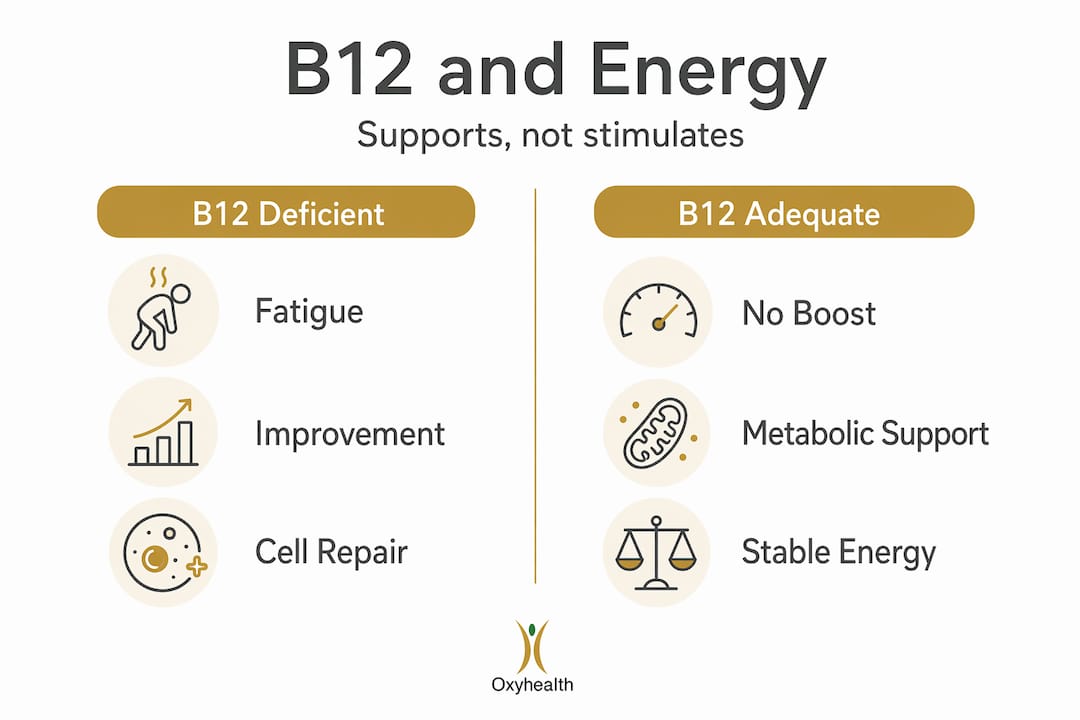
B12 acts as a metabolic co-factor, not a stimulant. If your B12 levels are already adequate, taking more of it will not give you a perceptible energy lift. The research is consistent on this point: vitamin B12 energy benefits occur primarily through correcting a deficiency, not by flooding an already sufficient system.
| Situation | Expected benefit from B12 supplementation |
|---|---|
| Confirmed B12 deficiency | Significant improvement in energy, often within days of treatment |
| Borderline or marginal deficiency | Moderate improvement, especially in fatigue and cognitive clarity |
| Normal B12 levels | Little to no measurable energy benefit |
The form of supplementation also matters considerably. For most people with a straightforward dietary shortfall, oral supplements work well. However, for those with malabsorption issues, including people with atrophic gastritis, Crohn’s disease, or those who have had gastric surgery, the gut cannot absorb oral B12 effectively. In these cases, injections bypass the gut entirely and deliver close to 100% of the dose directly into the body’s tissues.
There is also a nuance worth knowing about. Functional B12 deficiency can occur even when serum B12 levels appear normal. This happens when B12 is not being taken up effectively at the mitochondrial level. Specialised forms like hydroxycobalamin and adenosylcobalamin are better able to reach the mitochondria and nerve cells than standard cyanocobalamin supplements, making the form you choose potentially as important as the dose.
Pro Tip: If you suspect a functional deficiency, ask your GP about testing methylmalonic acid (MMA) levels. MMA is a more sensitive marker of cellular B12 status than serum B12 alone.
Who is most at risk of B12 deficiency
B12 deficiency is more widespread than most people realise, and certain groups face a substantially higher risk than others. Knowing where you sit on that spectrum is the starting point for doing something about persistent fatigue.
The populations most commonly affected include:
- Older adults. Gastric acid production declines with age, and acid is required to release B12 from food proteins. Many people over 50 absorb significantly less B12 from food than younger adults, even with an identical diet.
- Vegans and strict vegetarians. B12 is found almost exclusively in animal products. Without supplementation or fortified foods, plant-based diets will lead to deficiency over time.
- People with digestive conditions. Crohn’s disease, coeliac disease, and atrophic gastritis all interfere with B12 absorption. Those who have had bariatric surgery face the same challenge.
- People taking certain medications. Metformin, used widely for type 2 diabetes, and proton pump inhibitors, used for acid reflux, both reduce B12 absorption over the long term.
- Pregnant and breastfeeding women. B12 demand rises during pregnancy, and infants of B12-deficient mothers can develop deficiency quickly.
The symptoms worth watching for before deficiency becomes severe include unexplained fatigue that does not resolve with rest, a pins-and-needles sensation in the hands or feet, difficulty concentrating, low mood, and a sore or inflamed tongue. These symptoms often appear before anaemia is visible on a blood test, which is why standard tests can miss early deficiency entirely.
If you fall into one of the high-risk categories above and are experiencing any of these signs, pursuing testing proactively rather than waiting for things to worsen is the sensible course.
Practical steps to support your B12 and energy levels
Getting your B12 status right does not have to be complicated, but it does require a degree of intentionality, particularly if you are in a higher-risk group.
- Review your dietary sources. Prioritise B12-rich foods including beef, salmon, sardines, eggs, and dairy. If you follow a plant-based diet, fortified plant milks, nutritional yeast, and a reliable supplement are non-negotiable, not optional extras.
- Choose the right supplement form. Liquid B12 supplements tend to absorb more readily than standard tablets, particularly for those with any degree of gastric insufficiency. Liquid vitamin formulations offer a practical alternative to tablets for people who want to maximise uptake without going straight to injections.
- Optimise overall absorption. B12 absorption depends on a healthy gut environment, adequate stomach acid, and the presence of intrinsic factor. Limiting alcohol, managing stress, and supporting gut health all contribute indirectly to how well your body uses the B12 you consume. A good guide on optimising vitamin absorption can help you address this methodically.
- Pair B12 support with physical activity. Strength training, in particular, increases mitochondrial density in muscle tissue. More mitochondria means a greater capacity to generate ATP, so the metabolic benefits of adequate B12 are amplified when you are also building your body’s energy infrastructure.
- Get tested and get specific. Ask your GP for a serum B12 test and, if there is any reason to suspect a functional deficiency, request methylmalonic acid testing. If your results are borderline or your symptoms persist, discuss whether a loading phase of injections makes clinical sense for your situation.
Pro Tip: Severe deficiency typically requires 5 to 7 injections in the first week before moving to a maintenance schedule. Symptoms can begin improving within 48 to 72 hours of starting treatment.
My perspective on B12 and fatigue
I have followed the research on B12 and energy for a long time now, and the thing that consistently stands out to me is how often deficiency goes undetected for years. People present with fatigue, brain fog, and weakening muscles, go through the standard blood panel, and are told everything looks fine. The serum B12 result sits within the normal range, the full blood count shows no anaemia, and they leave without answers.
What I find genuinely under-appreciated is the gap between “normal on paper” and “functioning adequately at the cellular level.” The mitochondrial impact of marginal deficiency is real and measurable, but standard testing does not capture it. This is not a fringe view. The research supports it clearly.
What I would push back on, however, is the idea that B12 is some kind of universal energy solution. It is not. If your levels are genuinely adequate, topping up will not make you feel more alert or perform better physically. The role of B12 in metabolism is to support a process, not to accelerate it beyond its natural ceiling.
My honest view is that B12 deficiency is one of the most under-diagnosed contributors to fatigue in the UK, particularly among older adults and those on plant-based diets. If you are persistently tired and feel you have not had a satisfying answer, pushing for more sensitive testing is worth doing. B12 is one piece of a larger picture, but it is one that is too often skipped over.
— John
Supporting your energy with Oxyhealth

If this article has prompted you to take a closer look at your B12 status, Oxyhealth carries a carefully selected range of B12 supplements sourced from Global Healing, formulated for people who want quality they can trust. The liquid vitamin range is particularly well suited to those who want faster, more reliable absorption compared to standard tablets. Oxyhealth ships from the UK with same-day dispatch on orders placed before 2 p.m., and all purchases come with a 365-day satisfaction guarantee. Browse the full supplements range to find the formulation that fits your needs, or visit the Oxyhealth wellness store to explore related health kits and superfoods designed to support your wider energy and vitality goals.
FAQ
Does B12 give you instant energy?
No. B12 is a metabolic co-factor, not a stimulant. It supports energy production at the cellular level and only improves energy levels meaningfully when correcting an underlying deficiency.
What are the signs of B12 deficiency before anaemia develops?
Early signs include unexplained fatigue, pins and needles in the hands or feet, poor concentration, and low mood. These symptoms can appear before any abnormality shows up on a standard blood test.
Who benefits most from B12 supplementation for energy?
People with a confirmed or suspected B12 deficiency benefit most, including older adults, vegans, those with digestive conditions, and those on long-term metformin or proton pump inhibitors.
Are B12 injections better than oral supplements?
For people with malabsorption issues, yes. Injections bypass the gastrointestinal tract entirely and deliver close to 100% absorption, compared to the variable uptake of oral supplements.
Can you have a B12 deficiency with normal blood test results?
Yes. Functional deficiency can occur even when serum B12 appears normal, because standard tests do not measure how effectively B12 is being used at the mitochondrial level. Methylmalonic acid testing provides a more accurate picture.