
Vitamin B12 explained: benefits, sources, and UK supplement advice
TL;DR:
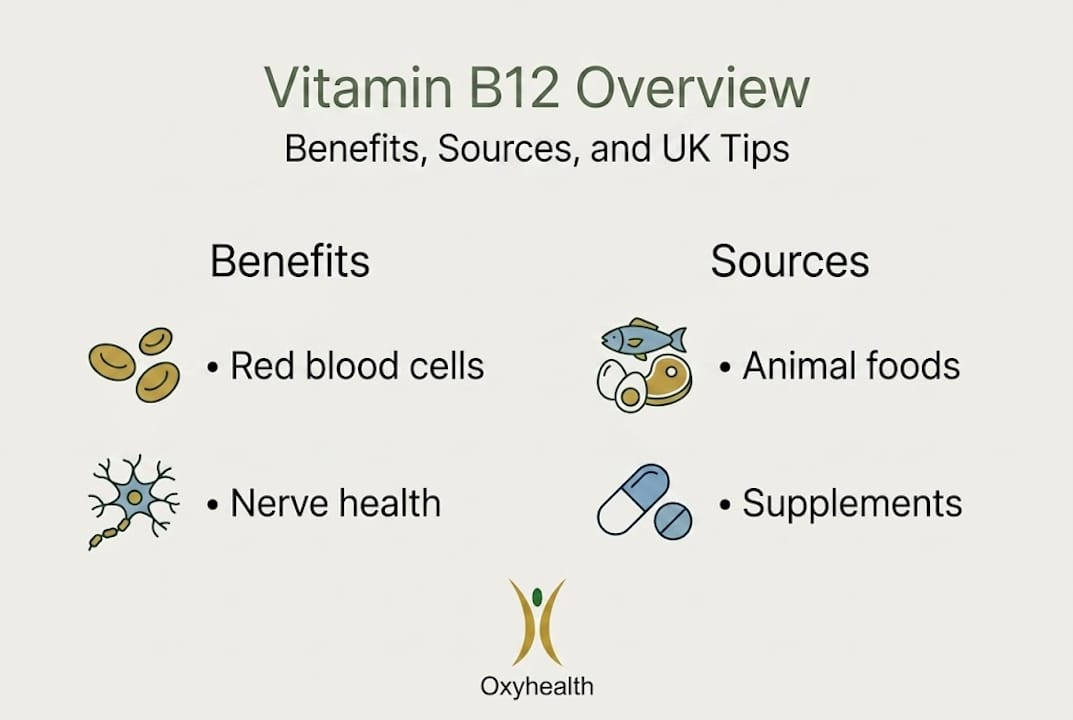
- Vitamin B12 is essential for red blood cells, nerve health, DNA synthesis, and energy metabolism.
- Most animal foods are primary B12 sources; vegans often need fortified foods or supplements.
- At-risk groups include vegans, the elderly, those with absorption issues, and individuals on certain medications.
Vitamin B12 is frequently dismissed as simply “an energy vitamin,” but that label barely scratches the surface of what this nutrient actually does inside your body. Millions of people in the UK are walking around with suboptimal B12 levels without knowing it, and the consequences reach far beyond feeling tired. Whether you eat meat every day or follow a fully plant-based diet, your B12 status deserves serious attention. This guide covers the science behind B12, the best dietary sources for UK eaters, who faces the greatest risk of deficiency, and exactly how to supplement safely and effectively.
Table of Contents
- What is vitamin B12 and how does it work?
- Vitamin B12 in your diet: main sources for the UK
- Who is at risk of vitamin B12 deficiency?
- Supplementing with vitamin B12: when, why and how much?
- Our view: why most people underestimate vitamin B12 risks
- Get targeted vitamin support for your wellness
- Frequently asked questions
Key Takeaways
| Point | Details |
|---|---|
| Vital for health | Vitamin B12 is essential for making red blood cells, nerve health, and energy metabolism. |
| Mainly in animal foods | Natural B12 sources are mostly animal-based, meaning vegans and some vegetarians must seek alternatives. |
| Supplements are safe | Supplementing is safe, especially for high-risk groups, as there is no known toxicity from excess intake. |
| Watch for hidden risks | Deficiency can develop silently, particularly in those with absorption issues, certain medicines, or older adults. |
What is vitamin B12 and how does it work?
Vitamin B12 is one of the most chemically complex vitamins known to science. As a water-soluble vitamin containing cobalt, it is essential for red blood cell formation, neurological function, DNA synthesis, and energy metabolism. That cobalt atom at its core is why B12 carries the family name “cobalamin.” Unlike most vitamins, your body can store B12 in the liver for years, which is both reassuring and deceptive — stores run out slowly enough that you might not notice deficiency until real damage has occurred.
There are several forms of cobalamin, but two matter most biologically: methylcobalamin and 5-deoxyadenosylcobalamin. These are the active forms your cells actually use. Methylcobalamin supports nerve health and helps convert homocysteine (an amino acid linked to cardiovascular risk when elevated) into methionine. 5-deoxyadenosylcobalamin is involved in breaking down certain fatty acids and amino acids inside the mitochondria, which are your cells’ energy-producing units. Understanding the vitamin roles in health that different forms play makes clear why a single deficiency can ripple across multiple body systems simultaneously.
The absorption process for B12 is genuinely intricate. First, stomach acid and an enzyme called pepsin release B12 from the protein it’s bound to in food. It then binds to a carrier protein called haptocorrin (also known as R-protein). In the small intestine, pancreatic enzymes strip B12 away from haptocorrin, allowing it to bind to intrinsic factor (IF), a glycoprotein produced by cells in the stomach lining. This B12-IF complex is then absorbed via receptor-mediated endocytosis in the terminal ileum (the end of the small intestine). Around 1% of a very large dose can also be absorbed passively through diffusion, bypassing this entire system — a detail that becomes clinically important for people who cannot produce intrinsic factor.
Here is a quick summary of what B12 does in the body:
- Red blood cell production: B12 is needed for cells to divide properly; without it, abnormally large, ineffective red blood cells form, causing megaloblastic anaemia.
- Nerve maintenance: It helps maintain the myelin sheath, the protective coating around nerve fibres.
- DNA synthesis: Every cell that divides needs B12 to replicate its genetic material accurately.
- Homocysteine regulation: Elevated homocysteine is associated with cardiovascular and cognitive risks.
- Energy metabolism: B12 supports the conversion of food into usable cellular energy.
| Function | Active form involved | Consequence of deficiency |
|---|---|---|
| Red blood cell formation | Methylcobalamin | Megaloblastic anaemia |
| Nerve fibre protection | Methylcobalamin | Tingling, numbness, nerve damage |
| DNA synthesis | Both forms | Impaired cell division |
| Fatty acid metabolism | 5-deoxyadenosylcobalamin | Fatigue, neurological issues |
| Homocysteine conversion | Methylcobalamin | Elevated cardiovascular risk |
“B12 deficiency can appear even when dietary intake seems adequate — because absorption, not intake alone, determines your actual B12 status.”
Given how vitamins and ageing interact, it is also worth noting that B12’s absorption efficiency naturally declines as we get older, making the elderly particularly vulnerable even if their diet has not changed. Learning how vitamins keep you healthy at every life stage is the first step to protecting yourself.
Vitamin B12 in your diet: main sources for the UK
Now that we understand what B12 is and how it works, let’s look at foods and products where you can actually get it, especially for those with different dietary patterns.
B12 occurs naturally only in animal products. This is not a grey area — no plant food naturally contains meaningful, bioavailable B12. The primary dietary sources include meat (particularly liver), fish such as salmon and cod, eggs, and dairy products including milk, cheese, and yoghurt. Liver is extraordinarily rich in B12; a single 75g serving of lamb’s liver can contain over 60 micrograms, far exceeding daily requirements.
The UK Reference Nutrient Intake (RNI) for B12 sits at 1.5 micrograms (mcg) per day for adults, which sounds small but is still genuinely difficult to reach without animal products. To put this in practical terms: two medium eggs provide approximately 2.8 mcg, a 75g portion of salmon delivers around 2.5 mcg, and a 200ml glass of whole milk contributes roughly 0.9 mcg. Meeting the RNI through food is straightforward for most omnivores, but it requires consistent, varied intake.
| Food source | Serving size | Approximate B12 content |
|---|---|---|
| Lamb’s liver | 75g | 60+ mcg |
| Salmon | 75g | ~2.5 mcg |
| Beef | 90g | ~2.0 mcg |
| Eggs (x2 medium) | ~120g | ~2.8 mcg |
| Whole milk | 200ml | ~0.9 mcg |
| Fortified plant milk | 200ml | ~0.6 to 1.2 mcg |
| Marmite | 8g | ~0.5 mcg |
| Fortified breakfast cereal | 30g | ~0.8 to 2.4 mcg |
For vegans and many vegetarians, getting enough B12 from food alone becomes genuinely challenging. Fortified foods are the practical solution: these include plant-based milks (oat, almond, soya), some breakfast cereals, and yeast extracts like Marmite. However, fortification levels vary between brands and products, making it unreliable as a sole source without careful label-reading. Our plant-based supplement advice explores this topic in more depth for those making the dietary shift.
Here are the key B12 food categories to know:
- Richest natural sources: Organ meats (liver, kidney), clams, mackerel, sardines
- Good everyday sources: Beef, salmon, cod, eggs, cheese, yoghurt
- Fortified plant foods: Soya milk, oat milk, some breakfast cereals, Marmite
- Unreliable sources: Fermented foods, spirulina, certain algae (not considered bioavailable)
You can explore the full picture of where to get B12 across different dietary patterns, including how much of each food you actually need daily.
Pro Tip: When choosing fortified cereals or plant milks, check the back-of-pack nutrition label specifically for B12 listed as “cyanocobalamin” or “methylcobalamin.” Not all plant-based products are fortified, and even those that are can differ significantly in their actual content per serving.
If your diet relies heavily on plant-based foods, dedicated B12 supplements for vegans are a reliable and efficient way to close the gap without relying on variable food fortification levels.
Who is at risk of vitamin B12 deficiency?
Understanding where B12 comes from is one thing, but knowing who’s most at risk, and why, is where prevention really starts.
In the UK, pernicious anaemia is the most common cause of B12 deficiency. It is an autoimmune condition in which the immune system attacks the stomach cells that produce intrinsic factor. Without intrinsic factor, dietary B12 simply cannot be absorbed, regardless of how much you eat. It is more prevalent than most people realise and often diagnosed only after years of vague, worsening symptoms.
Beyond pernicious anaemia, several other factors increase deficiency risk:
- Vegan and vegetarian diets with no fortified food or supplement use
- Crohn’s disease and other conditions affecting the terminal ileum
- Gastric surgery, including gastric bypass, which reduces stomach acid and intrinsic factor production
- Long-term use of proton pump inhibitors (PPIs), which suppress stomach acid needed for B12 release from food
- Metformin (commonly prescribed for type 2 diabetes) interferes with B12 absorption in the small intestine
- Older age: More than one in ten people over 75 are estimated to be B12 deficient due to declining stomach acid and intrinsic factor production
Statistic to note: Studies suggest that up to 11% of adults over 75 in the UK have biochemically low B12 levels, yet many remain undiagnosed because symptoms develop so gradually they are mistaken for normal ageing.
Symptoms of B12 deficiency include extreme fatigue, breathlessness, pale or yellow skin, a sore red tongue, mouth ulcers, pins and needles in the hands and feet, disturbed vision, irritability, depression, and cognitive difficulties. In severe, prolonged cases, neurological damage can become permanent if left untreated.

Reviewing your risk is made easier with resources like this overview of common UK nutrient deficiencies, which puts B12 into the context of broader nutritional gaps across the UK population. Our own guide to optimising vitamins in the UK also covers how to approach your intake strategically.
Pro Tip: Blood tests measure total serum B12, but this figure can be misleading. Some people with “normal” levels still have a functional deficiency because B12 is not being delivered into cells effectively. If you have persistent symptoms despite a normal test, ask your GP about testing homocysteine or methylmalonic acid levels, which are more sensitive markers of true B12 status.
Supplementing with vitamin B12: when, why and how much?
So who should supplement with B12, and how much is actually needed? Here’s what you need to know to get it right.
The good news is that oral B12 supplementation is safe, effective, and appropriate for most people. For those with dietary deficiency, including vegans and vegetarians, a daily oral dose of 10 to 50 mcg is typically sufficient to maintain healthy levels. For correction of established deficiency, higher doses may be recommended initially. The Vegan Society recommends either 10 mcg daily or 2,000 mcg weekly as a practical supplementation strategy for plant-based eaters.
Here is a step-by-step approach to getting B12 supplementation right:
- Identify your risk level: Are you vegan, vegetarian, elderly, on metformin or PPIs, or do you have a digestive condition? If yes, supplementation is strongly advisable.
- Choose the right form: Cyanocobalamin is widely available and well-studied. Methylcobalamin is the active form and preferred by some practitioners, particularly for nerve-related concerns.
- Select your dose: For prevention and dietary deficiency, 10 to 50 mcg daily is the standard range. For vegans, 2,000 mcg once weekly is an evidence-backed alternative.
- Consider your absorption ability: If you have pernicious anaemia or severe malabsorption, standard oral supplements will not be adequately absorbed. Injections become necessary in these cases.
- Review with your GP: Especially if you have existing health conditions, a history of gastric surgery, or are switching from injections to oral supplementation.
“High-dose vitamin B12 supplementation is considered safe; there is no established upper tolerable limit, and excess B12 is excreted in the urine. This makes it one of the most forgiving vitamins to supplement with.”
For those with pernicious anaemia, intramuscular hydroxocobalamin injections remain the gold standard in the UK, administered every two to three months lifelong. Hydroxocobalamin is preferred over cyanocobalamin in the UK because it is retained in the body for longer. Post-COVID, some UK practices have transitioned suitable patients from injections to high-dose oral tablets, with encouraging results — always discuss this with your own GP rather than making the switch unilaterally.
You can browse detailed B12 guidance on dosage, forms, and clinical considerations for a thorough evidence-based overview. Our supplement routine guide also covers how to integrate B12 within a wider daily wellness routine for optimal results.
Pro Tip: Taking your B12 supplement in the morning with breakfast can improve consistency, especially if you are also taking other vitamins. B12 does not generally interfere with other nutrients, making it simple to stack with your existing routine.
Explore the full range of B12 supplement options to find the format and potency that suits your needs, whether you are looking for maintenance support or corrective dosing.
Our view: why most people underestimate vitamin B12 risks
Conventional health messaging tends to frame B12 deficiency as a concern for vegans and the very elderly. That framing is too narrow, and it leaves a sizeable group of at-risk adults entirely unaddressed.
We see this regularly. Someone on long-term acid reflux medication, eating a perfectly balanced omnivore diet, develops subtle cognitive changes over several years. Their GP runs a standard blood panel, finds B12 within the “normal” reference range, and the real issue goes undetected because the test did not capture functional deficiency. By the time the connection is made, some neurological impact may already be present.
The safety profile of B12 supplementation is extraordinary. There is effectively no risk to supplementing at typical oral doses, even without a confirmed deficiency. Given this, the case for routine, proactive supplementation, particularly for anyone with even a mild absorption risk factor, is compelling. Rather than waiting for symptoms to force action, optimising your vitamin intake before deficiency takes hold is a far more intelligent approach.
As UK dietary habits continue to shift, with plant-based eating growing year on year, B12 deserves to be part of every health conversation, not just those with vegans in the room.
Frequently asked questions
Can vitamin B12 deficiency occur if I eat meat or dairy?
Yes, deficiency can affect meat and dairy eaters when absorption is impaired, for example due to pernicious anaemia, Crohn’s disease, gastric surgery, or long-term use of PPIs or metformin.
How quickly do symptoms of low vitamin B12 appear?
Symptoms can take several years to surface because B12 stores last between two and five years, but nerve damage that develops during this time can eventually become irreversible if untreated.
Is it possible to take too much vitamin B12?
No adverse effects are associated with high B12 intake; excess is excreted naturally in urine, and there is no established upper tolerable intake level for this vitamin.
Are B12 injections or tablets better for deficiency?
Tablets work effectively for most people, but those with pernicious anaemia or severe malabsorption require injections because oral absorption fails without functional intrinsic factor.
Should vegetarians and vegans in the UK take B12 supplements?
Yes, the British Dietetic Association recommends lifelong B12 supplementation for anyone on a plant-based diet, as no reliable plant food naturally provides bioavailable B12 in sufficient quantities.