
The role of vitamins in ageing: enhance vitality after 40
TL;DR:
- Targeted correction of deficiencies like vitamin D and B12 is more effective than broad multivitamins.
- Supplements support cellular processes but should be based on individual blood tests and needs.
- Whole foods often provide better nutrient absorption and synergy than isolated supplements for healthy aging.
Many adults over 40 reach for a daily multivitamin with the quiet confidence that they’ve done their bit for healthy ageing. It’s an understandable instinct. Yet vitamins act as potent antioxidants that modulate specific ageing hallmarks, meaning the real story is far more nuanced than simply swallowing a pill each morning. What genuinely moves the needle is identifying and correcting actual deficiencies, not broad-spectrum supplementation. This article cuts through the noise to explain what the evidence really shows, which vitamins matter most for UK adults over 40, and how to build a practical approach that supports long-term vitality.
Table of Contents
- How vitamins influence the ageing process
- Targeted correction: Vitamin D, B12, and common UK deficiencies
- Antioxidants, muscle, and cognition: What the evidence really shows
- Multivitamins, safety, and the best approach to supplementation
- Our perspective: Diet first, test next, then supplement with evidence
- Explore trusted supplements for healthy ageing
- Frequently asked questions
Key Takeaways
| Point | Details |
|---|---|
| Correct key deficiencies | Testing and addressing low vitamin D and B12 is the top priority for ageing well in the UK. |
| Diet beats pills | A plant-rich diet supplies vital antioxidants and nutrients better than routine supplements. |
| Target, don’t blanket | Personalised, evidence-based supplementation is safer and more effective than general multivitamin use. |
| Check before supplementing | Testing for deficiencies helps avoid the risks of under- or over-supplementation. |
How vitamins influence the ageing process
Now, let’s look at exactly how vitamins interact with your body as you age. The relationship is more sophisticated than most people realise, and understanding it changes how you think about supplementation entirely.
At a cellular level, vitamins support three critical processes: DNA repair, antioxidant regulation, and energy production within the mitochondria. As you move through your forties, fifties, and beyond, the efficiency of all three gradually declines. Your gut absorbs certain nutrients less effectively. Cellular repair mechanisms slow. Oxidative stress, the accumulation of unstable molecules that damage cells, becomes harder to keep in check.
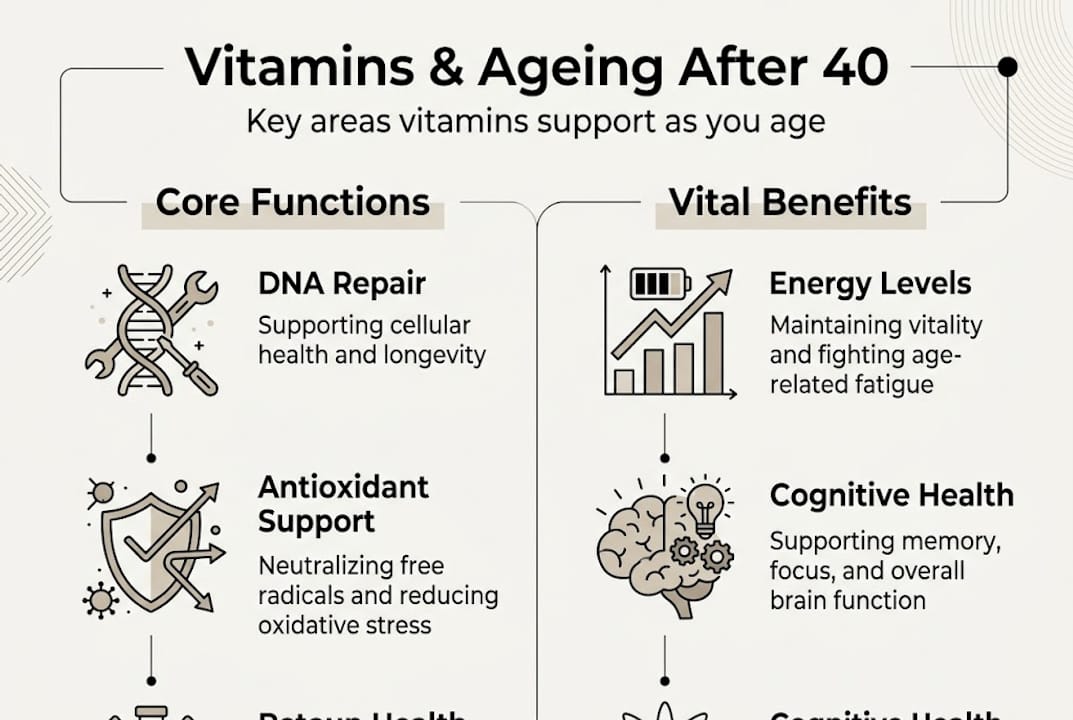
Vitamins modulate ageing hallmarks such as telomere attrition and genomic instability through their antioxidant effects. Telomeres are the protective caps on your DNA strands, and their gradual shortening is one of the clearest biological markers of ageing. Vitamins C and E, along with certain B vitamins, help slow this process when they’re present at the right levels. You can read more about how vitamin deficiencies affect ageing on our health hub.
Here’s a summary of what vitamins do at the cellular level:
- DNA repair: Folate and B12 support methylation, a process essential for copying and repairing DNA accurately.
- Antioxidant regulation: Vitamins C and E neutralise free radicals before they damage cell membranes and DNA.
- Energy production: B vitamins act as cofactors in the mitochondrial pathways that generate cellular energy.
- Immune modulation: Vitamin D regulates immune cell activity and reduces chronic low-grade inflammation.
| Vitamin | Primary ageing mechanism | Key risk if deficient |
|---|---|---|
| Vitamin D | Immune regulation, bone density | Fractures, immune decline |
| Vitamin B12 | DNA methylation, nerve function | Cognitive decline, anaemia |
| Vitamin C | Antioxidant defence, collagen | Poor wound healing, fatigue |
| Folate | DNA synthesis and repair | Elevated homocysteine, cardiovascular risk |
“More is not always better. Vitamins operate within optimal ranges, and exceeding them can trigger adverse effects rather than enhanced protection.”
This is the hormetic principle at work. A mild nutritional challenge, correcting a genuine shortfall, activates repair pathways. Flooding the system with excess vitamins does not amplify this effect. It can actually interfere with it. That’s the misconception worth unpacking before you spend another penny on supplements.
Targeted correction: Vitamin D, B12, and common UK deficiencies
Understanding mechanisms sets the stage for applying this knowledge to what matters most: the vitamins older UK adults actually need.
The UK’s climate and dietary patterns create a specific deficiency landscape. Vitamin D is the most widely recognised gap. The NHS recommends that everyone in the UK considers a vitamin D supplement during autumn and winter, when sunlight is insufficient for the skin to synthesise adequate amounts. For adults over 40, this recommendation carries extra weight because skin synthesis efficiency also declines with age.

B12 is the other critical concern. B-vitamins including folate, B12, B6, and riboflavin are essential cofactors in one-carbon metabolism, which underpins DNA synthesis, RNA production, and methylation. Between 9% and 20% of older UK adults are deficient or suboptimal in these nutrients. The consequences are not trivial. Elevated homocysteine, a marker linked to both cardiovascular disease and cognitive decline, is a direct result of B12 and folate shortfalls. NHS advice on B-vitamins confirms the importance of adequate intake across all age groups.
For bone health and broader longevity, vitamin D3 supplementation decreases mortality in older adults, according to Cochrane evidence, though not all proposed benefits are equally well supported. The bone and immune effects are the most robust.
Here’s a practical approach to checking and addressing your status:
- Request a blood test from your GP to check vitamin D and B12 levels. Both are standard NHS tests.
- Review your diet for animal-based B12 sources (meat, fish, dairy) or consider vegan B12 options if you follow a plant-based diet.
- Start vitamin D supplementation in October and continue through to March at minimum, as recommended by the NHS.
- Retest after three months to confirm your levels have improved before adjusting your dose.
- Consider a targeted supplement rather than a broad multivitamin if testing reveals a specific gap.
Pro Tip: Guessing your vitamin status is one of the most common and costly mistakes in supplement use. A simple blood test removes the guesswork entirely and helps you invest in what your body genuinely needs. Explore optimising vitamin intake for UK adults for a more detailed guide. Quality vitamin D3 supplements are also worth considering once your baseline is confirmed.
Antioxidants, muscle, and cognition: What the evidence really shows
With targeted correction covered, let’s disentangle the evidence for antioxidants and cognition. This is where popular belief and actual research diverge most sharply.
The AREDS formula, a specific combination of antioxidant vitamins C, E, beta-carotene, and zinc, has been shown to slow the progression of age-related macular degeneration. That’s a meaningful, evidence-backed benefit for eye health. When it comes to muscle function in older adults, antioxidant supplementation shows the most benefit when combined with regular physical activity, not as a standalone intervention.
Cognition is where things get particularly interesting. Flavanol supplementation improves cognitive test performance in older adults. Flavanols are plant compounds found in cocoa, berries, and green tea. Routine multivitamin use, by contrast, does not show the same cognitive benefit. This distinction matters enormously because many people assume their daily multivitamin is protecting their brain. The evidence simply doesn’t support that assumption.
Here’s where the evidence is strong versus weak for supplements in ageing:
Strong evidence:
- Vitamin D for bone density and immune function
- B12 and folate for homocysteine reduction and cognitive protection when deficient
- AREDS formula for slowing macular degeneration
- Flavanols (from food or targeted supplements) for cognitive function
Weak or insufficient evidence:
- Broad multivitamins for cognitive protection in well-nourished adults
- High-dose antioxidant pills for general longevity
- Vitamin C megadosing for immune enhancement
“Diet-based antioxidants consistently outperform isolated pill forms in research settings, likely because whole foods deliver compounds that work together synergistically.”
Pro Tip: Before purchasing an antioxidant supplement, ask whether you can get the same compound from food. Berries, leafy greens, and nuts deliver flavanols and vitamin E in forms your body recognises and uses efficiently. Browse key supplements for ageing when you’ve identified a gap that food alone can’t fill. Our guide on plant-based vitamin C is also worth reading. Understanding supplement quality and effectiveness will help you make better choices.
Multivitamins, safety, and the best approach to supplementation
So what about the popular multivitamin pill? Let’s look at safety and real-world strategies.
The honest answer is that routine multivitamin use offers little proven benefit for most well-nourished UK adults over 40. No strong evidence supports routine multivitamin or protein-energy supplements reducing mortality or improving physical function in older adults who are adequately nourished. That’s a Cochrane-level finding, not a fringe opinion.
More concerning is the risk of over-supplementation. High vitamin A intake is particularly problematic. Excess vitamin A intake above 1.5mg per day is associated with increased fracture risk in older adults. This is especially relevant for people who take a multivitamin containing retinol and also eat liver regularly. The two sources combined can push intake into harmful territory without anyone realising.
| Supplement type | Evidence of benefit | Key risk if overused |
|---|---|---|
| Targeted vitamin D3 | Strong (bone, immunity) | Hypercalcaemia at very high doses |
| Targeted B12 | Strong (if deficient) | Minimal at standard doses |
| Broad multivitamin | Weak (well-nourished adults) | Excess vitamin A, iron overload |
| High-dose antioxidants | Mixed | May interfere with exercise adaptation |
Practical guidelines for supplement use after 40:
- Test before you invest. Blood tests reveal actual deficiencies rather than assumed ones.
- Food first. A varied, plant-rich diet addresses most micronutrient needs without risk of excess.
- Target specific gaps. If you’re deficient in D or B12, supplement those specifically.
- Check for interactions. Some supplements interact with common medications. Speak to your GP or pharmacist.
- Review annually. Nutritional needs shift as you age. What worked at 45 may need adjusting at 60.
Explore liquid multivitamin guidance if absorption is a concern, as liquid forms can be more bioavailable for some individuals. For a full framework, our guide to creating your own supplement routine walks you through a personalised approach step by step.
Our perspective: Diet first, test next, then supplement with evidence
Bringing these findings together, here’s our honest take as health advocates: the supplement industry has done a remarkable job of convincing people that more is more. It isn’t. The adults we see benefiting most from supplementation are those who identified a genuine deficiency, addressed it with a targeted product, and built the rest of their nutrition from real food.
Generic supplement routines are outdated. The science has moved on, and personalised assessment is now the standard worth aiming for. Many UK adults overlook the fact that plant-rich food sources often deliver vitamins in forms that are better absorbed and more effective than isolated pill versions. A handful of walnuts, a portion of oily fish, or a daily serving of leafy greens can outperform an expensive supplement in many cases.
Testing for deficiencies ensures both effectiveness and safety. It also saves money. Spending on supplements you don’t need is not just wasteful; it can actively cause harm in some cases. Pro Tip: Ask your GP for a vitamin D and B12 panel, or use a reputable home test kit, before committing to any supplement routine. Supplementation works best when it’s chosen deliberately for proven gaps, not as a precaution against vague concerns. Start with personalising your vitamin strategy and build from there.
Explore trusted supplements for healthy ageing
If you’re considering practical next steps, here’s where to find quality supplement options and more tailored advice.
At Oxyhealth, every product we stock is chosen to align with evidence-based priorities: correcting known deficiencies, supporting optimal wellness, and avoiding unnecessary over-supplementation. Whether you’re looking for vitamin B12, vitamin D3, or targeted antioxidants, our range is sourced from trusted, natural producers.

Browse the full Oxyhealth supplements collection to find products matched to the deficiencies most common in UK adults over 40. If absorption is a concern, our liquid vitamins range offers highly bioavailable alternatives to standard capsules. Orders over £50 include free UK delivery, with same-day dispatch available for orders placed before 2 p.m.
Frequently asked questions
Which vitamin deficiency is most common in UK adults over 40?
Vitamin D and B12 deficiencies are most prevalent, with up to 20% of older adults showing suboptimal or deficient levels. Both have significant consequences for energy, cognition, and long-term health.
Should you take a daily multivitamin after 40?
Routine multivitamin use is not strongly supported by evidence for well-nourished adults. A targeted approach based on tested deficiencies is more effective and safer.
Can vitamin supplements slow down ageing?
Certain vitamins support cellular resilience and slow specific degeneration, but vitamins modulate ageing hallmarks most effectively when correcting a genuine deficiency rather than supplementing on top of adequate levels.
Are there risks to taking too many supplements?
Yes. Excess vitamin A above 1.5mg per day increases fracture risk in older adults, and high-dose antioxidants may interfere with the body’s natural exercise adaptation responses.
Recommended
- Unlock radiant skin: the role of skin nutrition in 2026 – Oxyhealth
- Supplements – Oxyhealth
- Why Choose Natural Vitamins for Wellness Success – Oxyhealth
- How to optimize vitamin intake: 40% UK adults need help – Oxyhealth
- How to Support Liver Detox Naturally for Lasting Vitality – Gutted.
- Rolle Af Vitaminer – Sådan Forbedres Søvn og Livskvalitet – Vitaminone.dk