
Step-by-step vitamin intake: optimise absorption in 5 steps
TL;DR:
- Most UK adults have dietary gaps in vitamin D, folate, and iron that may require targeted supplements.
- Timing and food combinations significantly influence vitamin absorption, emphasizing consistency over perfection.
- Supplementation should be personalized, based on confirmed deficiencies, life stage, and safe daily dosages.
Most UK adults make educated guesses about which vitamins they need, picking up supplements based on adverts, word of mouth, or vague notions of eating well. The trouble is, guessing leads to two equally unhelpful outcomes: gaps that leave you fatigued and run-down, or overloading on nutrients your body simply excretes or, worse, accumulates to harmful levels. Getting your vitamin intake right is genuinely simpler than the wellness industry makes it look. This article walks you through a clear, evidence-based method for assessing your needs, building a consistent routine, and fine-tuning absorption so every supplement or meal you choose actually works for you.
Table of Contents
- Prepare: Know your vitamin needs and diet gaps
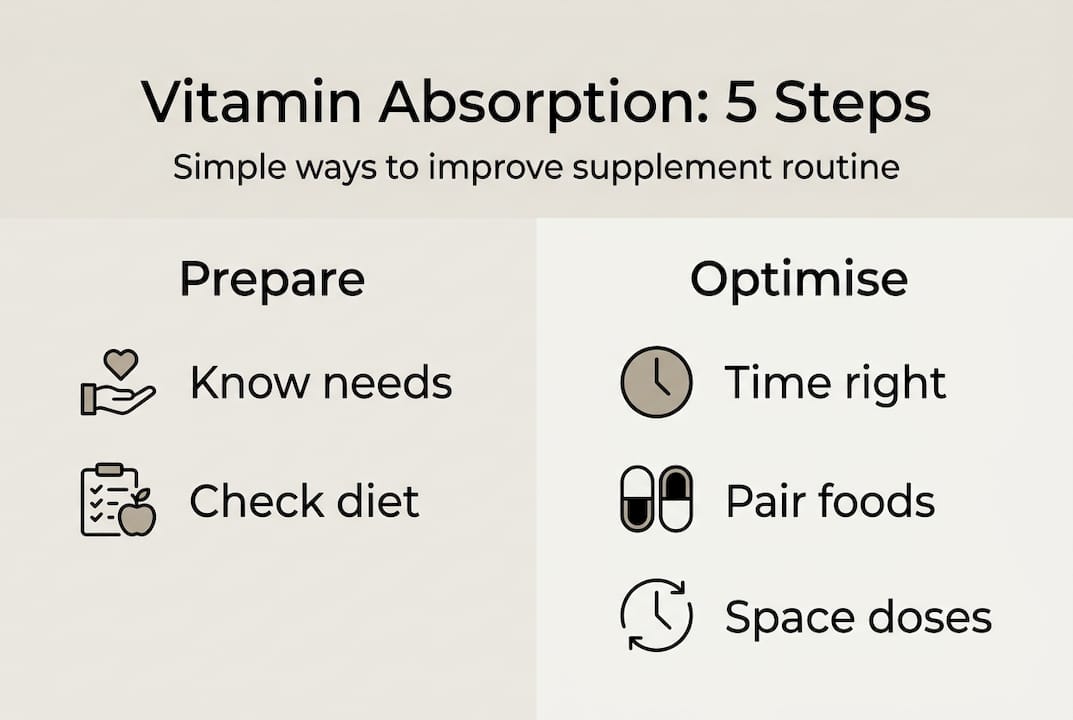
- Step-by-step: Build your ideal vitamin routine
- Absorption matters: Optimise timing and combinations
- Special cases and safety: Vegans, pregnancy, and upper limits
- A realistic view: Why routine beats perfection in vitamin intake
- Explore vitamins and wellness kits for your needs
- Frequently asked questions
Key Takeaways
| Point | Details |
|---|---|
| Assess your diet | A balanced diet covers most vitamin needs; address gaps before considering supplements. |
| Follow the stepwise plan | Take vitamins for genuine gaps at NHS recommended doses, adjusting for age, diet, or pregnancy. |
| Optimise absorption | Combine nutrients smartly, time supplements, and avoid common absorption mistakes. |
| Stay safe | Do not exceed upper limits and consult your GP in special cases or when unsure. |
| Consistency is key | Making vitamin intake a daily habit is more effective than chasing perfection. |
Prepare: Know your vitamin needs and diet gaps
Before you buy a single bottle, spend time understanding where you actually stand nutritionally. Most UK adults do not eat a perfectly balanced diet, and certain gaps are far more common than others. Common UK shortfalls include vitamin D, folate, and iron, three nutrients that affect energy, immunity, and cell production in a very real, daily way.
Your starting point should be an honest look at your usual meals and lifestyle. Consider these questions:
- Are you vegetarian or vegan? You may be at risk of low B12, iodine, and vitamin D.
- Are you pregnant or planning a pregnancy? Folate and iron become critical.
- Are you over 65? Absorption of B12 and vitamin D naturally declines with age.
- Do you spend most of your day indoors? Your vitamin D from sunlight will be limited, particularly from October through to March.
- Do you have a restrictive diet or food allergies that cut out whole food groups?
A useful next step is reviewing your diet against a basic nutrient framework. The table below shows the most common shortfall vitamins in the UK and the food sources that help address them.
| Vitamin | At-risk groups | Key food sources |
|---|---|---|
| Vitamin D | Everyone in UK autumn/winter | Oily fish, eggs, fortified foods |
| Folate | Women of childbearing age | Leafy greens, beans, fortified cereals |
| Iron | Women, vegans, athletes | Red meat, lentils, dark leafy vegetables |
| B12 | Vegans, older adults | Meat, dairy, fortified plant milks |
| Iodine | Vegans, dairy-free eaters | Fish, dairy, iodised salt |
If you suspect a deficiency, book a blood test through your GP. Self-diagnosing based on tiredness alone is unreliable. A GP can measure serum vitamin D, B12, ferritin, and folate levels accurately. Discovering a genuine shortfall before supplementing is the foundation of optimising vitamin intake properly. Diet improvements should always come first; targeted supplements are there to fill genuine gaps, not replace food.
Step-by-step: Build your ideal vitamin routine
With a clear picture of your dietary gaps, you can follow a practical sequence that removes the guesswork entirely.
- Review your diet honestly for two weeks, noting which food groups you consistently skip or under-eat.
- Seek professional advice if you fall into any at-risk category. A GP or registered dietitian can confirm deficiencies through testing rather than assumption.
- Choose supplements only for confirmed gaps. Avoid multi-vitamins that include nutrients you already consume in adequate amounts through food.
- Follow NHS-recommended doses. For example, 10 micrograms daily of vitamin D is advised for all adults throughout autumn and winter. Women planning a pregnancy or in the first 12 weeks should take 400 micrograms folic acid every day.
- Review your routine every year. Needs shift with age, season, health changes, and diet. What worked in your thirties may not suit you in your fifties.
You can also refer to BDA supplements advice for evidence-based guidance that goes beyond basic NHS messaging.
The table below helps match common life stages with typical supplement considerations.
| Life stage | Common needs | Notes |
|---|---|---|
| Adult men | Vitamin D (Oct to Mar) | Diet usually covers most needs |
| Adult women | Vitamin D, iron, folate | Iron more common if periods are heavy |
| Over 65 | Vitamin D, B12, calcium | Absorption of B12 declines with age |
| Pregnancy | Folic acid, vitamin D, iron | Begin folic acid before conception if possible |
| Vegan | B12, iodine, vitamin D | Requires ongoing supplementation |
For more detail on how requirements shift over time, the vitamin needs as you age guide covers the key transitions well. Once you settle on a routine, keep it simple. A daily supplement guide can help you structure your intake around existing meals and habits rather than creating a separate, complicated ritual.
Pro Tip: Set a phone reminder linked to a specific meal, such as breakfast or lunch, to take your supplements. Pairing supplementation with an existing habit dramatically increases consistency.

Absorption matters: Optimise timing and combinations
Even the best supplement becomes far less useful if you take it at the wrong time or alongside foods and drinks that block absorption. This is one of the most overlooked aspects of a vitamin routine.
Here is what actually matters when it comes to timing and food pairings:
- Fat-soluble vitamins (A, D, E, and K) must be taken with a meal containing some fat. No fat present means minimal absorption. A meal with eggs, olive oil, avocado, or nuts works well.
- Vitamin C taken alongside iron significantly improves how much iron your body absorbs. This is particularly useful for vegans getting iron from plant sources like lentils and spinach.
- Calcium and iron compete for absorption if taken together. Always separate them by at least two hours.
- Tea and coffee reduce iron absorption substantially. Tannins in these drinks bind to iron and block uptake. Avoid drinking either within an hour of an iron supplement.
- Zinc and copper also compete, so taking high-dose zinc long-term can inadvertently deplete copper levels.
As food combinations boost absorption, understanding the interaction between what you eat and what you supplement with can genuinely make the difference between a supplement working and being wasted.
If you are exploring formats that absorb rapidly, liquid vitamin options are worth considering, as they are absorbed more readily than some capsule-based forms. For those who prefer plant-sourced nutrients, learning more about plant-based vitamin C offers a useful comparison with synthetic versions.
Safety note: Fat-soluble vitamins accumulate in body tissue and are not simply excreted. Excess vitamin A and D in particular can reach toxic levels over time. Always stick to recommended doses.
Pro Tip: If you take multiple mineral supplements, schedule them at least two hours apart. For guidance on how minerals interact, the resource on mineral interactions gives a clear breakdown.
Special cases and safety: Vegans, pregnancy, and upper limits
Some groups need more targeted attention, and certain mistakes in supplementation carry real health risks.
Vegans and vegetarians often require ongoing B12, iodine, and vitamin D supplementation because these nutrients are either absent from or poorly available in plant-based diets. This is not a short-term fix; it is a permanent consideration for anyone avoiding animal products.
Key groups with specific needs:
- Pregnant women: Avoid vitamin A supplements (retinol) entirely. High doses in early pregnancy are linked to birth defects. Use folic acid and vitamin D only, unless advised otherwise by a GP or midwife. Refer to NHS pregnancy supplement advice for full guidance.
- Children aged 1 to 4: Should receive daily vitamins A, C, and D unless they drink 500ml or more of formula milk per day.
- Older adults: Reduced stomach acid affects B12 absorption, and reduced sun exposure increases vitamin D risk. Higher vigilance is needed.
- Those on medication: Some supplements interact with prescribed drugs. Always inform your GP of what you take.
Statistic to note: Adults should not exceed 100 micrograms (4,000 IU) of vitamin D per day. Excess vitamin D leads to hypercalcaemia, a condition where calcium builds up in the blood causing nausea, weakness, and kidney problems.
The most common mistakes people make:
- Taking vitamin A supplements during pregnancy
- Buying low-quality supplements without verified contents; understanding the risks of synthetic supplements helps here
- Double-dosing accidentally by not checking whether a food is already fortified
- Ignoring upper limits because supplements feel “natural”
- Giving adult doses to children
For a trusted reference on what is safe at every life stage, the vitamin safety guidelines resource is a solid starting point. If you are supplementing for children, children’s supplements formulated for age-appropriate doses are always preferable to splitting adult products.
Always consult your GP or midwife before starting any supplement if you are pregnant, breastfeeding, or managing a health condition.
A realistic view: Why routine beats perfection in vitamin intake
Here is something the wellness industry rarely admits: the timing precision and supplement stacking that fills online forums matters far less than simply taking the right supplement consistently, every day, for months on end. Most of the measurable benefit in supplementation comes from correcting a genuine deficiency and maintaining adequate levels over time. Whether you take vitamin D at 8am with butter on your toast or at noon with a handful of nuts is genuinely secondary to whether you take it at all.
The obsession with optimisation can actually become counterproductive. It creates a mental burden that leads people to abandon their routine entirely when life gets busy. A simple, sustainable habit beats a technically perfect protocol you follow for three weeks.
Supplements serve a real purpose for true gaps, but wholesome, varied meals remain the foundation. Vegetables, legumes, whole grains, quality proteins, and healthy fats deliver nutrients in combinations and quantities that no supplement catalogue can fully replicate. For ongoing guidance on real-life vitamin intake optimisation, revisit your routine once a year with a GP or dietitian, adjusting for changes in your health, diet, and age.
Explore vitamins and wellness kits for your needs
Now you understand the step-by-step approach, putting that knowledge into action means choosing supplements from sources you can actually trust. At Oxyhealth, we stock a carefully curated range of natural health products dispatched from the UK, with same-day shipping on orders placed before 2pm.
Browse our full range of premium supplements for targeted, high-quality options across vitamins, minerals, and nutrients. If rapid absorption is a priority, our liquid vitamin collection offers formats that your body can use quickly and efficiently. For those looking at a broader health reset, our health kits bundle complementary products together for a more complete approach. Every product comes with our 365-day satisfaction guarantee.
Frequently asked questions
Can I get all vitamins from diet alone in the UK?
Most vitamins can be obtained from a balanced diet, but vitamin D and B12 may require supplements, particularly for vegans and during winter months when sunlight is insufficient.
What is the best time to take vitamin supplements for highest absorption?
Vitamins A, D, E, and K absorb best with a fat-containing meal, and absorption improves significantly when you avoid tea or coffee within an hour of taking iron supplements.
How do I know if I am taking too much of a vitamin?
Check your supplement label against NHS upper limits; excess fat-soluble vitamins accumulate in body tissue and can cause harm over time, unlike water-soluble vitamins which are excreted.
Do children need vitamin supplements in the UK?
Children aged 1 to 4 should take daily vitamins A, C, and D as recommended by NHS guidance, unless they consume 500ml or more of infant formula daily which already contains these nutrients.
Recommended
- How to optimize vitamin intake: 40% UK adults need help – Oxyhealth
- Daily Supplement Routine Guide for Optimal Wellness – Oxyhealth
- The role of vitamins in ageing: enhance vitality after 40 – Oxyhealth
- Improve Gut Health Process Naturally: Step-by-Step Guide – Oxyhealth
- How to boost your immune system: holistic steps that work | Healthspan Holistic