
Why supplement with B12? Benefits explained for UK health
TL;DR:
- Many people are unaware that B12 deficiency can affect all ages and diets, not just vegans or the elderly.
- B12 is essential for nerve health, red blood cell production, and DNA synthesis, with deficiency leading to serious neurological and blood-related issues.
- Absorption problems caused by gut conditions, age, or medications often require supplements like high-dose oral B12, which is equally effective as injections for most, and safe at high doses.
Most people assume B12 deficiency is strictly a vegan problem or something that only affects the elderly. That assumption can be genuinely harmful. Megaloblastic anaemia, fatigue, and neurological damage are among the serious consequences of leaving low B12 unaddressed, and they can develop quietly over months before anyone notices. What makes this nutrient especially tricky is that you can eat a seemingly balanced diet and still fall short, particularly if your gut isn’t absorbing it properly. This guide cuts through the confusion, explaining who genuinely needs B12, why deficiency happens, and how to supplement with confidence.
Table of Contents
- What does vitamin B12 do in the body?
- Who is at risk of B12 deficiency in the UK?
- How B12 is absorbed and why some people need supplements
- Types, doses, and safety of B12 supplementation
- Why B12 supplementation advice is often misunderstood
- Find B12 and other essentials at Oxyhealth
- Frequently asked questions
Key Takeaways
| Point | Details |
|---|---|
| B12 is vital for health | It supports nerve function, energy, and red blood cells, so deficiency has serious effects. |
| Risk is wider than you think | Vegans, those over 60, and people on certain medicines often need to supplement. |
| Oral supplements often work well | Oral B12 is safe and effective for most, with injections for special medical needs. |
| Choose safe, tailored doses | Stick to NHS guidelines and consult experts to personalise your supplement plan. |
What does vitamin B12 do in the body?
B12 is not a single-purpose nutrient. It sits at the intersection of three critical biological processes: nerve cell maintenance, red blood cell production, and DNA synthesis. Without enough of it, those systems start to break down in ways that are both measurable and deeply uncomfortable.
The role of vitamins in health is often reduced to vague notions of “energy” or “immunity,” but B12 is more specific. It is essential for the production of myelin, the protective sheath around your nerve fibres. When myelin degrades, signals between your brain and the rest of your body misfire. That’s where symptoms like tingling, numbness, and balance problems come from.
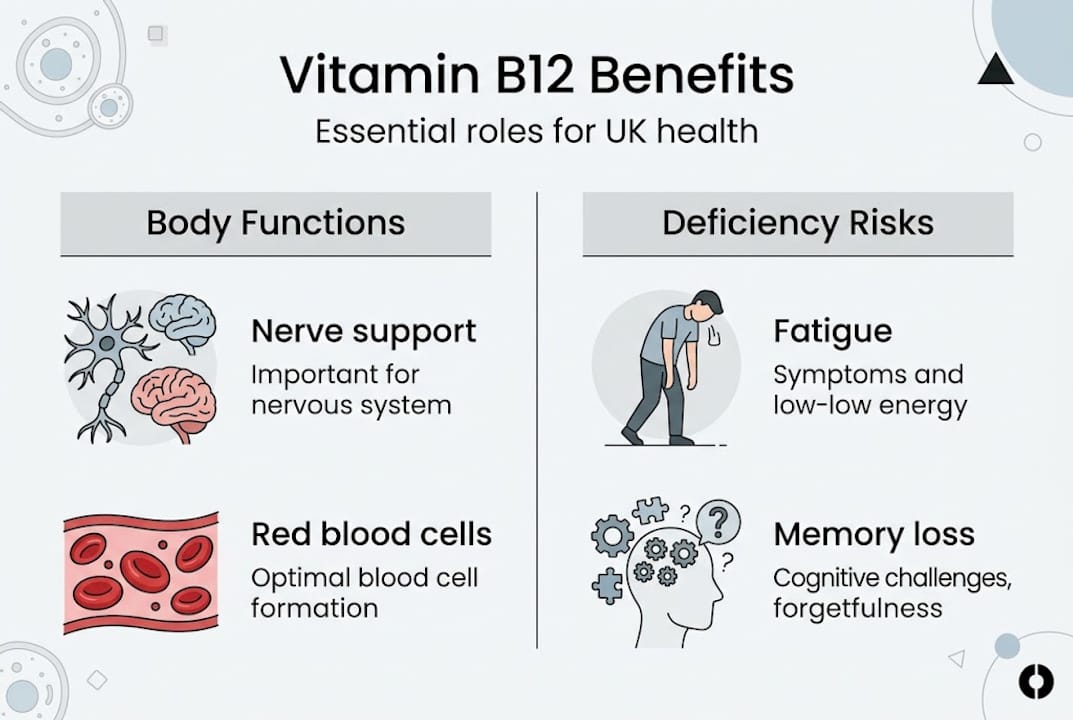
On the blood side, B12 works alongside folate to produce healthy red blood cells. Without it, your body makes oversized, malformed cells that cannot carry oxygen efficiently. The result is megaloblastic anaemia, fatigue, and cognitive problems, which are far more disabling than simply feeling a bit tired.
Early symptoms are easy to dismiss:
- Persistent tiredness and lack of energy
- Pins and needles in the hands or feet
- A sore, red, or inflamed tongue
- Difficulty concentrating or memory lapses
- Mood changes, including low mood or irritability
Advanced deficiency can produce irreversible nerve damage, severe depression, and even dementia-like symptoms. The uncomfortable truth is that neurological symptoms can appear even when anaemia has not yet developed, which means waiting for a blood count to flag something is not always a reliable safety net.
Deficiency also isn’t always about diet. Malabsorption caused by gut conditions, age-related decline in stomach acid, and certain medications all interfere with how your body extracts B12 from food. Understanding these mechanisms is what separates useful supplementation advice from oversimplified guidance.
Key fact: B12 is stored in the liver, and it can take two to five years for stores to deplete after intake drops. This is why deficiency often creeps up slowly and goes undetected until symptoms are significant.
Who is at risk of B12 deficiency in the UK?
Risk for B12 deficiency is far broader than most people expect. Diet matters, but it is only one part of the picture. Key causes of deficiency in the UK include pernicious anaemia, vegan and vegetarian diets, older age, gastrointestinal surgery, and certain medications.
| Risk factor | Reason B12 is affected |
|---|---|
| Vegan or vegetarian diet | B12 is found almost exclusively in animal products |
| Pernicious anaemia | Autoimmune destruction of intrinsic factor needed for absorption |
| Age over 60 | Reduced stomach acid limits B12 extraction from food |
| Gastrointestinal surgery | Removal of stomach sections reduces intrinsic factor production |
| Metformin use | Commonly prescribed diabetes drug reduces B12 absorption |
| Proton pump inhibitors | Suppress acid production needed for B12 release from food |
Vegans and vegetarians must supplement lifelong, as there are no reliable plant-based sources of B12. Older adults face a different problem: even if they eat meat and dairy, subclinical low B12 is closely linked to brain ageing and cognitive decline, and their guts simply absorb less of it over time.

For those exploring B12 and healthy ageing, the evidence is clear that maintaining adequate levels in later life is genuinely protective for brain function and mobility.
Those optimising vitamin intake as part of a broader health strategy should also check whether their other supplements or medications are interfering with B12 status.
Pro Tip: Nitrous oxide, commonly used recreationally, destroys active B12 in the body almost immediately. Even a single session can trigger acute deficiency in someone whose stores are already low. This is an underreported risk in younger adults who may otherwise consider themselves low-risk.
Other overlooked groups include people who have had bariatric surgery, those with Crohn’s disease or coeliac disease, and anyone who has taken metformin for more than a year without B12 monitoring.
How B12 is absorbed and why some people need supplements
B12 absorption is a multi-step process that is surprisingly easy to disrupt. Understanding it helps explain why eating B12-rich foods is not always sufficient.
Here is how normal absorption works:
- Stomach acid and pepsin release B12 from food proteins.
- B12 binds to a protein called intrinsic factor, produced by stomach cells.
- This B12-intrinsic factor complex travels to the end of the small intestine.
- Specialised receptors in the ileum absorb the complex into the bloodstream.
- The liver stores surplus B12 for future use.
If any step fails, whether from low stomach acid, missing intrinsic factor, or damaged gut receptors, absorption fails regardless of dietary intake. This is what the B12 absorption mechanism research from King’s College London makes clear: the bottleneck is often physiological, not dietary.
Supplements bypass some of these barriers through passive absorption, which does not require intrinsic factor. At high enough doses, roughly 1% of oral B12 is absorbed passively even without intrinsic factor. This makes high-dose oral supplements genuinely effective for many people.
| Method | Requires intrinsic factor | Best suited for |
|---|---|---|
| Dietary B12 | Yes | Healthy adults with no absorption issues |
| Standard oral supplement | Partially | Dietary deficiency, mild malabsorption |
| High-dose oral supplement | No (passive) | Pernicious anaemia, moderate malabsorption |
| Intramuscular injection | No | Severe malabsorption, acute deficiency |
Oral B12 is equivalent to injections for most people, according to 2025 RCT and Cochrane review data. Intramuscular injection remains the preferred route only when malabsorption is severe or the patient cannot reliably take oral supplements.
For those seeking convenient, effective formats, liquid B12 options offer fast absorption and are particularly easy to dose precisely, which matters for people managing ongoing deficiency.
Types, doses, and safety of B12 supplementation
Choosing the right form of B12 matters more than most supplement labels suggest. The main forms you’ll encounter are cyanocobalamin, methylcobalamin, adenosylcobalamin, and hydroxocobalamin. Methylcobalamin and adenosylcobalamin are the active, bioavailable forms your body uses directly, while cyanocobalamin requires conversion.
Available formats include:
- Oral tablets or capsules: Widely available, affordable, and effective for dietary deficiency
- Sublingual (under the tongue): Absorbs through the mouth lining, useful for those with mild absorption issues
- Liquid drops: Easy to dose, often contain active forms, and suit people who struggle with tablets
- Intramuscular injections: Administered by a healthcare professional, reserved for severe deficiency or significant malabsorption
For UK adults, the Reference Nutrient Intake (RNI) for B12 is 1.5 micrograms per day. However, treatment doses for deficiency are far higher: the NHS recommends 1,000 micrograms daily orally, or hydroxocobalamin injections for those with pernicious anaemia or significant malabsorption.
Vegans should aim for at least 10 micrograms daily from supplements, or a higher weekly dose of 2,000 micrograms to ensure adequate passive absorption throughout the week.
Pro Tip: Taking B12 in the morning is a practical choice since it can support energy metabolism throughout the day. Sublingual or liquid forms are worth considering if you’re over 60, as they sidestep some of the absorption challenges associated with ageing.
Safety concerns are minimal. High doses of B12 are non-toxic, with no established upper limit, because the body simply excretes any excess through urine. This makes it one of the safest vitamins to supplement, even at doses many times higher than the RNI.
For those looking to start, the organic B12 supplement at Oxyhealth provides a clean, vegan-friendly formula. Browsing the wider supplements collection is useful if you want to pair B12 with complementary nutrients.
Why B12 supplementation advice is often misunderstood
Here is something mainstream B12 guides rarely say plainly: having a “low-normal” blood result does not automatically mean you need supplements, and having a “normal” result does not mean you are fine. Symptoms matter more than a number on a lab sheet.
The debate between oral and intramuscular B12 has long been settled in favour of oral equivalence for most patients, yet many UK GPs still default to injections purely out of habit. Equally, the supplement industry profits from pushing high-dose products to people whose B12 status is genuinely adequate.
Under-supplementing is a real risk for vegans, older adults, and those on metformin. But over-relying on supplements without addressing the root cause, whether that’s pernicious anaemia or gut damage, is also a missed opportunity for proper care.
Our view, drawing on the evidence around real-world vitamin use, is that every UK resident in an at-risk group should push for symptom-driven testing and a personalised conversation with their GP, rather than either ignoring the issue or self-medicating based on generic advice.
Find B12 and other essentials at Oxyhealth
If the evidence has convinced you that your B12 intake needs attention, the next practical step is finding a supplement you can trust. At Oxyhealth, we stock a carefully selected range designed for UK health-conscious adults who want clean, effective options backed by quality assurance.
Frequently asked questions
Who needs to supplement with B12 the most?
Vegans, vegetarians, older adults, those with digestive disorders, and people with pernicious anaemia need B12 supplements most, as dietary and absorption factors place them at highest risk of deficiency.
Can you get enough B12 from food alone?
Many people do, but food alone is unreliable for those on plant-based diets, older adults, or anyone with absorption problems that prevent them extracting B12 effectively from what they eat.
Is oral B12 as effective as injections?
For most people with dietary deficiency, oral B12 equals injections in effectiveness. Intramuscular injections are only necessary when significant malabsorption prevents the gut from absorbing even high-dose oral supplements.
Is it safe to take high doses of B12 daily?
Yes. High doses carry no toxicity because the body eliminates any excess through urine, and clinical trials have not identified an upper safe limit for daily B12 intake.