
The role of digestive enzymes in your health
TL;DR:
- Digestive enzymes are essential for breaking down nutrients into absorbable molecules, supporting long-term health. Proper enzyme function depends on thorough chewing, stomach acidity, gut motility, and microbiota health, while deficiencies can cause malabsorption and digestive discomfort. Supporting your natural enzyme production through diet, mindful eating, and gut health practices is often more effective than relying on supplements, which should be used with professional guidance when necessary.
Most people think of digestive enzymes as something you take in a capsule when your stomach plays up. The reality is far more interesting. The role of digestive enzymes in your body is continuous, precise, and absolutely non-negotiable for turning food into the fuel and nutrients your cells actually use. Without them, a meal rich in protein, healthy fats, and complex carbohydrates would pass through you largely unabsorbed. Understanding how these molecules work, where they come from, and when they genuinely need support is one of the most practical things you can do for your long-term health.
Table of Contents
- Key takeaways
- The role of digestive enzymes explained
- What actually activates your enzymes
- When enzyme levels fall short
- Digestive enzyme supplements: what they can and cannot do
- Supporting your natural enzyme function
- My honest take on the enzyme conversation
- Support your digestion with Oxyhealth
- FAQ
Key takeaways
| Point | Details |
|---|---|
| Enzymes are not optional extras | Your body produces digestive enzymes naturally; they are required for every meal you eat. |
| Different enzymes target different nutrients | Amylase, lipase, and proteases each break down specific macronutrients at specific sites in the gut. |
| pH and chewing both matter | Enzyme effectiveness depends on stomach acidity and thorough mechanical breakdown before enzymes act. |
| Insufficiency has real consequences | Conditions like lactose intolerance and exocrine pancreatic insufficiency cause measurable malabsorption. |
| Supplements are not a substitute for diet | OTC enzyme products vary widely in quality and are not a replacement for good digestive habits. |
The role of digestive enzymes explained
Your digestive system is essentially a disassembly line. Food arrives as complex molecules, and by the time nutrients reach your bloodstream, they have been broken into their smallest usable components. Digestive enzymes catalyse this breakdown of carbohydrates, fats, and proteins into absorbable molecules. No enzyme means no absorption. It really is that direct.
The function of digestive enzymes covers three major nutrient categories, and each has its own specialist:
- Amylase is produced by the salivary glands and the pancreas. It targets starches, breaking long carbohydrate chains into simpler sugars that the small intestine can absorb. Digestion of carbohydrates actually begins in your mouth the moment you start chewing.
- Proteases (including pepsin, trypsin, and chymotrypsin) dismantle proteins into individual amino acids. Pepsin works in the acidic environment of the stomach, while trypsin and chymotrypsin are released by the pancreas and continue the job in the small intestine.
- Lipase is produced mainly by the pancreas and breaks dietary fats into fatty acids and glycerol, which can then cross the intestinal wall into the bloodstream.
- Lactase acts in the small intestine to digest lactose, the sugar found in dairy products.
- Sucrase breaks down sucrose (table sugar) into glucose and fructose in the small intestine.
| Enzyme | Substrate | Primary site of action |
|---|---|---|
| Amylase | Starches and carbohydrates | Mouth and small intestine |
| Pepsin | Proteins | Stomach |
| Trypsin / Chymotrypsin | Proteins | Small intestine |
| Lipase | Dietary fats | Small intestine |
| Lactase | Lactose (dairy sugar) | Small intestine |
| Sucrase | Sucrose (table sugar) | Small intestine |
The importance of digestive enzymes becomes clearest when you consider that your body cannot store nutrients it cannot absorb. Even the most nutritious diet falls short if the enzymatic machinery is not working properly.
What actually activates your enzymes
Knowing which enzymes exist is one thing. Understanding what switches them on and keeps them working is where most people’s knowledge gaps lie.
Chewing reduces food particle size, increasing the surface area available for enzymes to act on. A large chunk of bread gives amylase far less to work with than the same piece chewed thoroughly. Mechanical digestion is not just a preamble to the real process. It is part of it.
Beyond chewing, enzyme activity depends on gut transit and motility. If food moves through too quickly, enzymes do not have enough contact time with their substrates. If it moves too slowly, other issues arise. The gut is a dynamic environment, not a static tube.
pH is another critical factor. Pepsin, for instance, only functions in the highly acidic conditions of the stomach. Move it to the alkaline environment of the small intestine and it becomes inactive. Enzymes are pH-dependent, and suboptimal stomach acidity can impair enzyme function before digestion even gets going properly.
Finally, your gut microbiota plays a supporting role that is often underestimated. Microbiota and host enzymes work together, with gut bacteria mimicking or augmenting host enzymatic functions and influencing overall digestive efficiency. A disrupted microbiome does not just affect immunity. It affects how well you digest your food.
Pro Tip: If you regularly feel bloated after meals, look at how fast you eat before reaching for a supplement. Slowing down and chewing thoroughly can meaningfully improve enzyme contact time and reduce gas production.
When enzyme levels fall short
There is a meaningful difference between feeling a bit gassy after a rich meal and having a genuine enzyme insufficiency. Understanding where you sit on that spectrum matters.
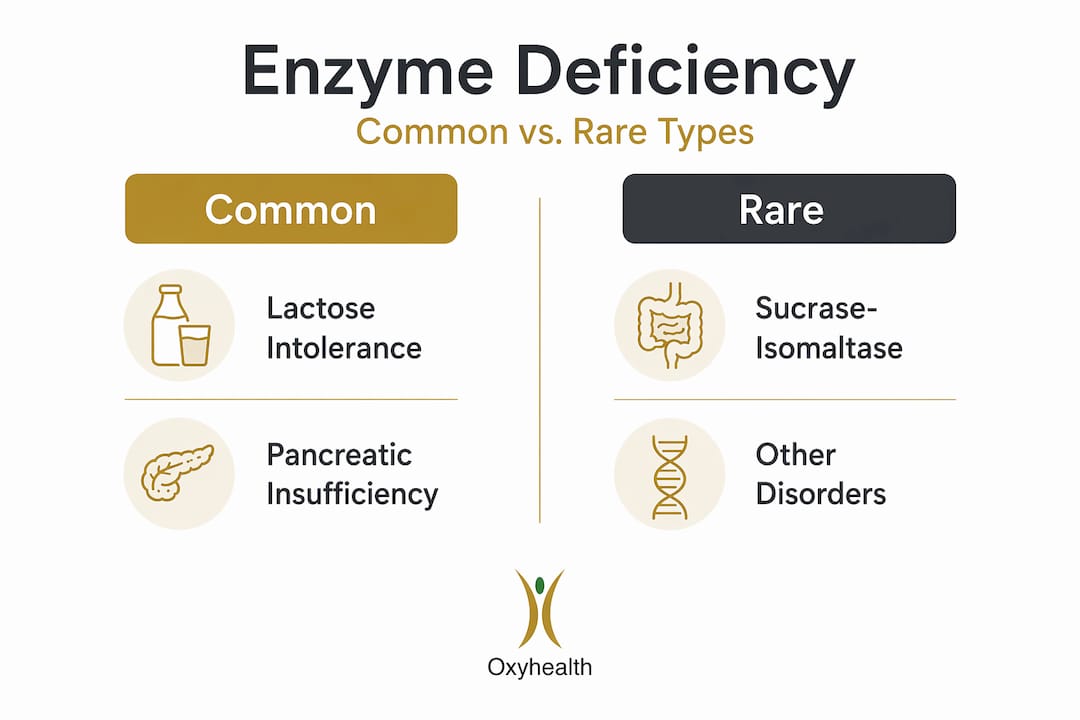
Lactose intolerance is the most common enzyme deficiency worldwide. When lactase production drops, undigested lactose ferments in the colon, producing gas, bloating, and diarrhoea. It is not an allergy. It is a straightforward enzyme gap.
Exocrine pancreatic insufficiency (EPI) occurs when the pancreas fails to produce sufficient digestive enzymes overall. This leads to malabsorption of fats in particular, causing oily, foul-smelling stools, unintended weight loss, and nutritional deficiencies. Symptoms of enzyme insufficiency include bloating, gas, diarrhoea, and oily stools, all indicating that nutrients are passing through unabsorbed.
Sucrase-isomaltase deficiency is rarer but causes significant discomfort after consuming sucrose, often misdiagnosed as irritable bowel syndrome.
| Condition | Enzyme affected | Key symptoms |
|---|---|---|
| Lactose intolerance | Lactase | Bloating, gas, diarrhoea after dairy |
| Exocrine pancreatic insufficiency | All pancreatic enzymes | Oily stools, weight loss, malnutrition |
| Sucrase-isomaltase deficiency | Sucrase | Bloating and diarrhoea after sugar intake |
Pancreatic enzyme replacement therapy (PERT) is the only FDA-regulated digestive enzyme treatment, prescribed specifically for EPI. Over-the-counter supplements are not equivalent and should not be used as a substitute for medical diagnosis and treatment in serious cases. If you suspect a clinical deficiency, a GP or gastroenterologist is the right starting point.
Digestive enzyme supplements: what they can and cannot do
The digestive enzyme supplements market is large, enthusiastic, and frequently overstated. Here is an honest breakdown.
Popular supplements often contain broad enzyme blends including protease, amylase, and lipase, sometimes with alpha-galactosidase added for complex carbohydrates found in legumes and cruciferous vegetables. For someone with mild digestive discomfort or a specific food sensitivity, these blends can provide genuine relief from gas and bloating.
What they cannot do is equally worth knowing:
- They are not regulated to the same standard as prescription PERT. Potency and purity vary significantly between products.
- Many enzyme supplements make unsupported claims about weight loss or flattening the stomach. Experts are clear that there is no credible evidence for these effects.
- Enzyme-rich foods like raw pineapple (bromelain) and papaya (papain) are often marketed as digestive aids. While these enzymes exist in the fruit, the quantities involved are unlikely to make a meaningful difference to your overall digestive capacity.
- Altered pH can degrade supplements before they reach the part of the gut where they are needed. Enteric coating matters, and not all products have it.
Beyond supplementation, enzymatic hydrolysis reduces antinutrients such as phytic acid in foods, improving mineral absorption. This is more relevant to food processing technology than to taking a capsule, but it illustrates that the role of enzymes in digestion extends well beyond the obvious macronutrient breakdown.
Pro Tip: If you are considering an enzyme supplement, look for one that specifies enzyme activity in standardised units (such as FCC units) rather than just milligrams. Milligrams tell you the weight of the ingredient, not how active it actually is.
Supporting your natural enzyme function
Rather than defaulting to supplements, there is a great deal you can do to support your body’s own enzyme production and effectiveness. These steps are not complicated, but they are consistently underused.
- Chew your food properly. Aim for 20 to 30 chews per mouthful for denser foods. This is not a figure plucked from nowhere. Mechanical breakdown is mandatory before enzymes can work effectively, and most people rush this step entirely.
- Eat a whole-food diet. Natural enzymes work best with a nutrient-dense diet. Fibre, micronutrients, and varied plant foods support the gut environment that makes enzyme activity possible.
- Protect your stomach acid. Avoid overusing antacids unless medically necessary. Adequate stomach acidity is required to activate pepsin and to trigger the release of pancreatic enzymes downstream.
- Support your gut microbiota. Fermented foods like kefir, live yoghurt, sauerkraut, and kimchi introduce beneficial bacteria that work synergistically with host enzymes to improve digestive efficiency.
- Limit heavily processed foods. Ultra-processed products tend to be low in fibre, high in additives, and designed for rapid absorption. They do not challenge or support your digestive system in any meaningful way.
- Speak to a healthcare professional before starting supplements. This is especially true if you have persistent symptoms. Self-diagnosing an enzyme deficiency and treating it with an OTC product can mask something that needs proper investigation. For broader guidance on improving gut health naturally, building good daily habits is where the real gains are.
My honest take on the enzyme conversation
I’ve spent years reading the research and watching how the supplement industry communicates digestive enzyme benefits to the public. What strikes me most is the inversion of priorities. People reach for a capsule before they have even considered whether they are chewing properly, eating enough fibre, or giving their gut microbiome the conditions it needs to function.
The science on enzyme supplementation is genuinely mixed for healthy individuals. Where I see real value is in specific, diagnosed conditions. EPI patients need PERT. Someone with confirmed lactase deficiency benefits from lactase supplements when consuming dairy. That is targeted, evidence-based use. What I am far more sceptical about is the broad marketing of enzyme blends as a general wellness upgrade.
Individual variation is real and significant. Two people eating the same meal can have very different digestive experiences based on their microbiome composition, stomach acid levels, and eating speed. That variation is not usually solved by a supplement. It is usually addressed by slowing down, eating better, and paying attention to what your gut is telling you.
The most underrated digestive health advice I can give you is this: treat your gut as a system, not a collection of isolated problems. Enzyme production, microbiota balance, mechanical digestion, and diet quality are all connected. Fix the system, and the enzymes tend to follow. You can explore Oxyhealth’s digestive health guide for a broader view of how these pieces fit together.
— John
Support your digestion with Oxyhealth
If you have read this far and you are ready to take a more considered approach to digestive health, Oxyhealth has put together a range of natural supplements and health kits designed with exactly that in mind.
Oxyhealth stocks enzyme and gut health supplements sourced from Global Healing, formulated with quality and natural ingredients as the priority. For those looking to combine digestive support with a broader cleanse approach, the health kits and cleanse programmes offer structured options that complement the dietary habits covered in this article. All orders over £50 qualify for free UK delivery, with same-day dispatch available for orders placed before 2 p.m. Browse the full Oxyhealth supplement range and find what fits your needs.
FAQ
What is the main role of digestive enzymes?
Digestive enzymes break down carbohydrates, proteins, and fats into molecules small enough to be absorbed through the intestinal wall. Without them, nutrients from food cannot enter the bloodstream regardless of diet quality.
How do digestive enzymes work in the body?
Each enzyme targets a specific nutrient type and works within a specific pH range and location in the digestive tract. Amylase starts in the mouth, proteases work in the stomach and small intestine, and lipase acts primarily in the small intestine with the help of bile.
What are the signs of digestive enzyme insufficiency?
Common signs include persistent bloating, excessive gas, loose or oily stools, and unexplained weight loss. These symptoms suggest that nutrients are not being properly broken down or absorbed and warrant a conversation with your GP.
Do digestive enzyme supplements actually work?
For people with diagnosed deficiencies such as lactose intolerance or exocrine pancreatic insufficiency, targeted enzyme supplements can be highly effective. For otherwise healthy individuals, the evidence for broad enzyme blends improving general digestion is limited, and many weight loss claims are unsupported.
What types of digestive enzymes should I look for in a supplement?
Look for supplements containing protease, amylase, and lipase as a minimum. Products that list enzyme activity in standardised FCC units rather than just milligrams give you a more accurate picture of potency. Enteric coating is worth seeking out to protect enzymes from stomach acid degradation before they reach the small intestine.