
Mineral supplementation explained: benefits, risks, smart use
TL;DR:
- Minerals are essential nutrients vital for nearly every physiological process in the body.
- Whole food sources are generally superior to supplements, which should target specific deficiencies.
- Unnecessary supplementation poses risks; testing and professional guidance are key for safe use.
Reaching for a mineral supplement feels like common sense, yet the reality is far more nuanced than most product labels suggest. The idea that more always means better is one of the most persistent myths in nutrition, and it can lead to wasted money at best or genuine health risks at worst. Understanding when minerals are truly needed, where to get them, and how the body actually absorbs them puts you firmly in control. This guide works through the evidence on mineral types, food versus supplement sources, absorption science, safety limits, and UK regulation, so you can make genuinely informed decisions about your nutritional routine.
Table of Contents
- What are minerals and why are they essential?
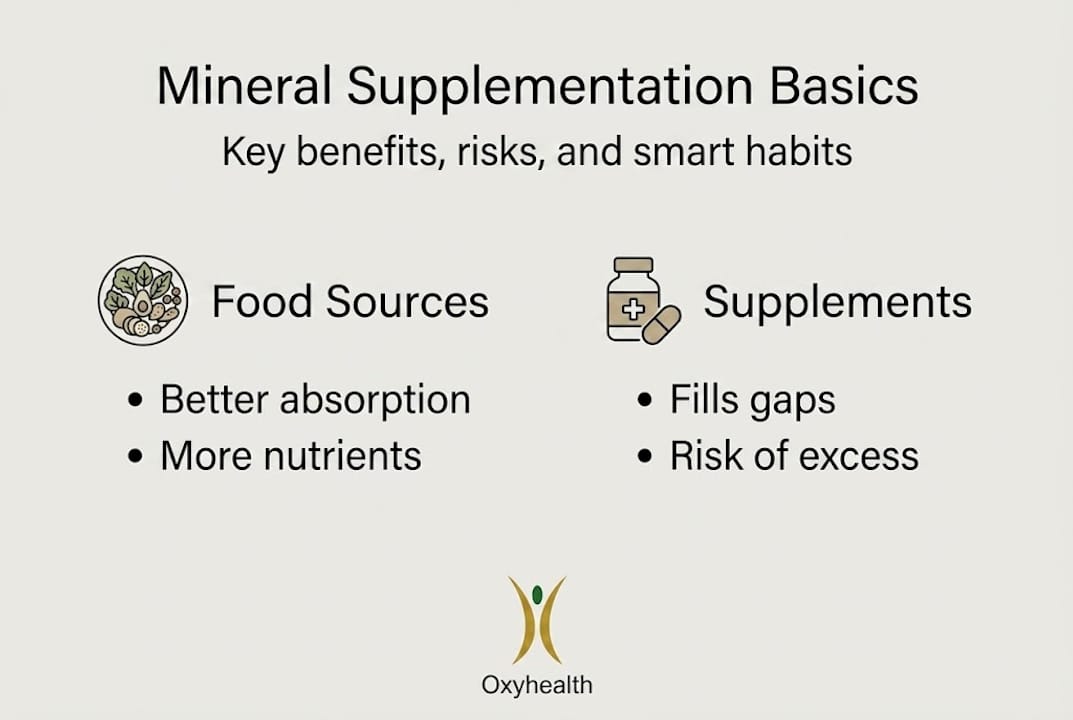
- Food versus supplements: Getting minerals the right way
- Who needs mineral supplements? Recognising special cases
- How mineral supplements work and what affects absorption
- Efficacy, safety, and legal status of mineral supplements in the UK
- Our take: Why a personalised, food-first approach always wins
- Ready to optimise your mineral intake?
- Frequently asked questions
Key Takeaways
| Point | Details |
|---|---|
| Food first principle | Prioritise a balanced diet for minerals before considering supplements. |
| Supplements for gaps | Use supplements only for diagnosed deficiencies or specific needs, e.g., pregnancy or vegan diets. |
| Beware excess risks | Taking too many minerals can harm your health—stick to proven dosages. |
| Absorption matters | Mineral form, food interactions, and personal health impact how well supplements work. |
| Check UK regulations | Choose quality products and know that UK supplements are regulated as foods, not medicines. |
What are minerals and why are they essential?
Minerals are not exotic additions to a healthy diet. They are fundamental. Every cell in your body depends on them, and even small shortfalls can quietly disrupt how you feel and function day to day.
At the most basic level, minerals are inorganic elements found naturally in soil and water that plants absorb and animals consume. Unlike vitamins, which are organic compounds, minerals retain their chemical structure whether they pass through food, soil, or a supplement capsule. That structural stability matters because it shapes how your body uses them.
There are two main categories to understand:
- Macrominerals are needed in larger amounts. These include calcium, magnesium, potassium, phosphorus, sodium, chloride, and sulphur. Calcium builds and maintains bones and teeth. Magnesium supports muscle function, nerve signalling, and energy production. Potassium helps regulate blood pressure and fluid balance.
- Trace minerals are required in far smaller quantities but are no less critical. Iron carries oxygen through the blood. Zinc supports immune response and wound healing. Selenium acts as a powerful antioxidant. Iodine regulates thyroid hormones that govern metabolism.
The biological functions these minerals perform are remarkably wide-ranging. Essential micronutrients support building bones and teeth, controlling body fluids, energy production, enzyme activation, and oxygen transport, touching nearly every physiological system you have.
Even a marginal deficiency in magnesium, for instance, can contribute to muscle cramps, poor sleep, and low energy long before any clinical test flags a problem.
This is why the conversation about minerals rarely fits into a simple checklist. Understanding natural detoxification and minerals reveals how interconnected these nutrients are with your body’s ability to process and eliminate waste. Similarly, the role of vitamins works alongside mineral status in ways that make treating them in isolation a mistake. Think of minerals and vitamins less as individual supplements and more as members of a team, where each position affects every other.
Food versus supplements: Getting minerals the right way
Now that the building blocks are clear, the practical question becomes: where should you actually get your minerals from?
Whole food sources have a significant advantage that no supplement can fully replicate. When you eat a handful of pumpkin seeds, a portion of sardines, or a bowl of lentils, you receive minerals alongside co-factors like fibre, phytonutrients, and complementary vitamins that support absorption and use. A supplement delivers an isolated compound without that nutritional context.
Food sources are superior to supplements for most nutrients, with evidence suggesting supplements show little broad health benefit except possibly vitamin D, and that high-dose use without medical advice carries real risks. That is a striking finding from Harvard’s nutrition research, and it should shift how you think about the supplement aisle.
That said, supplementation is not redundant. A balanced diet typically provides sufficient minerals, but supplementation is advised for those with deficiencies, specific needs, or poor absorption. The NHS identifies clear scenarios where a food-first approach genuinely falls short.
When supplementation makes practical sense:
- During pregnancy, when folic acid and vitamin D requirements increase sharply
- On a vegan or strict vegetarian diet, where B12, iron, zinc, and selenium can be harder to obtain
- During winter months in the UK, when sunlight exposure is insufficient for adequate vitamin D synthesis
- In older adults, where gastric acid production declines and absorption of certain minerals like magnesium and calcium weakens
| Source | Advantages | Limitations |
|---|---|---|
| Whole foods | Co-factors aid absorption; broader nutrient profile | Amounts vary by soil quality and cooking method |
| Supplements | Reliable dosage; useful for specific deficiencies | No co-factor context; quality varies widely |
| Fortified foods | Accessible; targets common gaps | Often low doses; limited mineral range |
Pro Tip: If you are unsure where to start, review the supplements collection with a specific nutrient gap in mind rather than buying a broad multivitamin. Targeted supplementation is almost always more effective than a scattergun approach.
For those following plant-based diets, plant-based supplements offer an informative look at how to meet mineral needs without animal-derived ingredients.
Who needs mineral supplements? Recognising special cases
The mineral supplement market often implies that everyone benefits from taking something extra. The evidence does not support that. Most healthy adults eating a genuinely varied diet will cover their mineral needs through food alone. The people who see real benefit from supplementation tend to fall into well-defined categories.
Here are the groups where supplementation is evidence-based:
- Pregnant and breastfeeding women. The NHS recommends 400mcg of folic acid and 10mcg of vitamin D daily during pregnancy, given the increased physiological demands that food alone often cannot meet.
- Vegans and strict vegetarians. Plant foods do not contain B12 at meaningful levels, and the bioavailability of iron and zinc from plant sources is lower than from animal sources.
- Older adults. Reduced stomach acid output, lower sun exposure, and declining kidney function can all compromise mineral absorption and utilisation.
- People with absorption conditions. Coeliac disease, Crohn’s disease, and inflammatory bowel conditions impair nutrient absorption significantly, sometimes requiring targeted supplementation under medical supervision.
- Those on certain medications. Some common drugs, including proton pump inhibitors and metformin, deplete specific minerals over time.
Before starting any supplement, testing your actual levels matters enormously. A GP can arrange blood tests for vitamin D, iron, and ferritin. Without that baseline, you risk supplementing unnecessarily or at the wrong dose.
The myth that multivitamins are a sensible insurance policy for everyone deserves some pushback. If your diet is genuinely varied and you have no underlying condition affecting absorption, a daily multivitamin is unlikely to deliver measurable benefit. It may give you peace of mind, but it rarely fills meaningful nutritional gaps.
Pro Tip: Before adding any supplement to your routine, read through daily supplement routines for guidance on timing, stacking, and structuring your intake sensibly.
How mineral supplements work and what affects absorption
Knowing you need a mineral is only half the picture. How well your body absorbs and uses it depends on factors most supplement labels never mention.

The form of the mineral in a supplement matters more than most people realise. Iron is a clear example. Haem iron, found in animal products like red meat and liver, is absorbed at roughly 20 to 30 per cent efficiency. Non-haem iron from plant foods and most supplements is absorbed at between 2 and 10 per cent. That gap is substantial, and it explains why someone taking an iron supplement on a plant-based diet may still struggle to restore their levels without dietary adjustment or a higher-bioavailability supplement form.
Absorption varies significantly by form: factors like vitamin D aiding calcium uptake and deficiencies arising from diet, absorption issues, or medications all shape how much of a mineral actually reaches your cells.
Here is a summary of key absorption factors:
| Mineral | Absorption booster | Absorption blocker |
|---|---|---|
| Iron | Vitamin C | Calcium, phytates, tannins in tea |
| Calcium | Vitamin D, magnesium | Oxalates (in spinach), excess sodium |
| Zinc | Protein-rich meals | Phytates, high iron supplementation |
| Magnesium | B6, adequate stomach acid | Alcohol, high sugar intake |
- Taking calcium and iron at the same time reduces the absorption of both.
- Drinking tea with meals significantly reduces non-haem iron uptake.
- Magnesium supplements taken with food are generally better tolerated than on an empty stomach.
Timing your supplements thoughtfully, separated from conflicting foods or medications, can make a meaningful difference to how effectively your body uses them.
For a deeper look at how ingredient quality affects what your body actually receives, the article on supplement quality covers what to look for in a reputable product.
Efficacy, safety, and legal status of mineral supplements in the UK
A common assumption is that supplements sold in UK health shops must have passed rigorous safety testing. That assumption deserves correction.
Mineral supplements are regulated as foods in the UK, not medicines. No pre-market efficacy proof is required, quality standards are variable, and manufacturers cannot legally make medicinal claims. This does not mean supplements are inherently unsafe, but it does mean the burden of due diligence falls on you as the consumer.
Safety concerns arise most commonly from excess, not from the supplements themselves. Consider these well-documented risks:
- High calcium intake above 2,500mg per day raises the risk of kidney stones and may affect cardiovascular health.
- Excess zinc interferes with copper absorption, potentially causing anaemia and nerve damage over time.
- Selenium at high doses causes selenosis, a condition marked by hair loss, brittle nails, and nerve problems.
- High-dose magnesium supplements frequently cause diarrhoea and gastrointestinal discomfort.
Knowing the upper safe limits for any mineral you supplement is not optional reading, it is a fundamental part of using supplements responsibly.
If you experience an adverse reaction from a supplement, you can report it directly to the Food Standards Agency. Choosing products from brands with transparent ingredient sourcing and third-party testing significantly reduces your risk. Understanding why quality matters in supplement selection is essential before committing to any product. For a broader look at the advantages of formulations closer to food-based nutrition, natural supplement benefits offers useful context.
Our take: Why a personalised, food-first approach always wins
After reviewing the evidence, what strikes us most is how aggressively the supplement industry has normalised daily supplementation for people who simply do not need it. The food-first model is not old-fashioned caution. It reflects how the body evolved to receive nutrients, with co-factors, enzymes, and fibre all working together in ways an isolated capsule cannot replicate.
The “test, don’t guess” principle matters because blind supplementation does not just waste money. It can actively skew your nutrient balance. Excess zinc blocking copper absorption is a real clinical problem that emerges from well-intentioned but uninformed use.
When supplements are warranted, choosing what high-quality supplements mean in practical terms separates genuine support from expensive placebo. We believe the smartest approach treats supplementation as a targeted intervention for documented gaps, not a daily habit adopted because a marketing campaign made it feel essential. Proven, quality options for clear needs, guided by testing and professional advice, will always outperform trend-driven, full-spectrum stacking.
Ready to optimise your mineral intake?
If the evidence here has helped you think more clearly about where you actually stand with mineral nutrition, the natural next step is finding products that meet the quality bar the research demands.
Frequently asked questions
Which minerals do most UK adults lack?
Vitamin D and iron are the most common deficiencies across the UK population, particularly during winter months or among those following plant-based diets. Supplementation targets specific needs such as pregnancy, deficiency, or poor absorption rather than general preventive use.
Is it safe to take multiple mineral supplements at once?
Combining supplements without guidance raises the risk of nutrient interactions and excess intake. High calcium, excess zinc, and elevated selenium each carry documented risks when taken beyond safe upper limits, so always consult a doctor or nutritionist first.
How do I know if I need supplements?
A blood test arranged through your GP is the most reliable way to identify a genuine deficiency. Prioritising diet for minerals and supplementing only where testing confirms a gap is the approach the NHS recommends.
What is the main risk of mineral over-supplementation?
Excess intake of certain minerals causes measurable harm. Calcium above 2,500mg daily risks kidney stones, selenium excess causes hair and nail loss, and too much magnesium leads to persistent gastrointestinal problems. Knowing safe upper limits before supplementing is essential.