
How to read supplement labels: a clear guide
TL;DR:
- Reading supplement labels carefully allows consumers to differentiate between marketing claims and factual ingredient information. The Supplement Facts panel and ingredient list are the most regulated and trustworthy parts of any supplement label, while front-of-pack claims often lack regulation and require critical evaluation. Verifying quality through independent third-party certifications and understanding legal disclaimers empower consumers to make informed health decisions.
Supplement shelves are full of bold promises, and the labels doing the promising are rarely straightforward. Knowing how to read supplement labels properly is one of the most practical skills you can develop for your health. An NHS doctor has noted that labels frequently omit or misrepresent key ingredient information, leaving consumers to make decisions based on marketing rather than fact. This guide cuts through the noise so you can shop with confidence and stop guessing.
Table of Contents
- Key takeaways
- How to read supplement labels: the core components
- Evaluating claims and marketing language
- A step-by-step process for reading any supplement label
- Common mistakes when interpreting supplement labels
- Verifying quality beyond the label
- My take on why label literacy matters more than ever
- Supplements you can actually trust
- FAQ
Key takeaways
| Point | Details |
|---|---|
| Start with serving size | Always check serving size first, as all nutrient amounts on the label are based on this figure. |
| Trust the facts panel | The Supplement Facts panel is more reliable than front-of-pack claims, which are largely unregulated. |
| Scrutinise claim language | Words like “natural” and “supports” carry little legal weight; look for verified evidence instead. |
| Check for certifications | Third-party seals such as USP or NSF indicate independent quality testing beyond the label. |
| Know the disclaimers | Structure/function claims must carry a legal disclaimer, but enforcement is limited. |
How to read supplement labels: the core components
Before you can judge a supplement, you need to know what each part of the label actually represents. The Supplement Facts panel and ingredient list are the most regulated and reliable sections on any supplement package. Everything else is largely marketing territory.
Here is what to look for and what each element tells you:
- Supplement Facts panel. This box lists every active ingredient, the amount per serving, and the percentage of Daily Value where applicable. Think of it as the only genuinely controlled section of the entire label.
- Serving size. Declared at the top of the panel, this tells you the quantity the manufacturer considers one dose. All nutrient figures you see below are based on this number, not the whole container.
- Active ingredients and amounts. These are the compounds the product claims to deliver benefit from. Amounts are typically listed in milligrams (mg), micrograms (mcg), or International Units (IU). Each unit matters. For example, vitamin D is often expressed in IU, while B vitamins tend to appear in mg or mcg.
- % Daily Value. Where shown, this percentage compares the ingredient amount to a reference daily intake. Gaps in the column (“*”) simply mean no reference value has been established, not that the ingredient is ineffective or dangerous.
- The ingredient list. Like food labels, this section lists everything in the product by weight in descending order. The first ingredient is present in the greatest amount. Watch for fillers, binders, and artificial additives buried near the end.
- Common units and what they mean. IU is not directly comparable across nutrients. 400 IU of vitamin D is roughly 10 micrograms, for instance. If you see an unfamiliar unit, a quick cross-reference with a reputable source will clarify it.
Pro Tip: If you struggle to compare products side by side, convert all amounts to the same unit before making a decision. Most manufacturers use different units deliberately, which makes direct comparisons unnecessarily difficult.
Evaluating claims and marketing language
The front of a supplement packet is where manufacturers have the most creative freedom. Understanding supplement labels means learning to separate claims from facts.
Front-of-pack language falls into several categories, and they carry very different levels of credibility. Nutrient content claims such as “high in vitamin C” are relatively tightly regulated. Structure/function claims such as “supports healthy joints” are far less so. Manufacturers making these structure/function statements must, under DSHEA legislation, include a legal disclaimer stating the product has not been evaluated by the FDA to treat, cure, or prevent any disease. That disclaimer is not just legal boilerplate. It signals the difference between a tested medical claim and a marketing message.
There are also several terms that sound meaningful but have little regulatory substance:
- “Natural.” Vague claims like “natural” have no strict legal definition on supplement packaging. A product can describe itself as natural while containing synthetic compounds.
- “Organic.” Certified organic does carry legal weight when the certification body is named. But “made with organic ingredients” is a much weaker claim that allows for significant non-organic content.
- “Whole food” or “plant-based.” These phrases gesture at quality but do not confirm potency, purity, or effective dosage.
- “Clinically proven.” This phrase is frequently misused. Always ask: proven in what study, on how many participants, and published where?
The inconvenient truth about supplement regulation is that a product can legally carry a health-related claim while carrying almost no obligation to prove it works. The disclaimer at the bottom of the label is your signal to dig deeper, not to walk away reassured.
A step-by-step process for reading any supplement label
Once you understand the components, you need a reliable process. Here is a practical sequence that works for any supplement, from a basic vitamin D capsule to a complex herbal blend.
| Step | Action | What to check |
|---|---|---|
| 1 | Check serving size | How many capsules, tablets, or ml constitute one dose? |
| 2 | Review active ingredients | Are the amounts within known effective ranges? |
| 3 | Assess the ingredient list | Any allergens, artificial additives, or excessive fillers? |
| 4 | Read all claims carefully | Are structure/function claims accompanied by a disclaimer? |
| 5 | Cross-reference with your needs | Does the dose align with professional advice or your personal health context? |
Step 1: Serving size first, always. Nutrition experts consistently emphasise that serving size is the most important starting point when reading any nutritional label. A supplement boasting 1,000mg of vitamin C per “serving” means nothing if the serving is two tablets and you are only taking one.
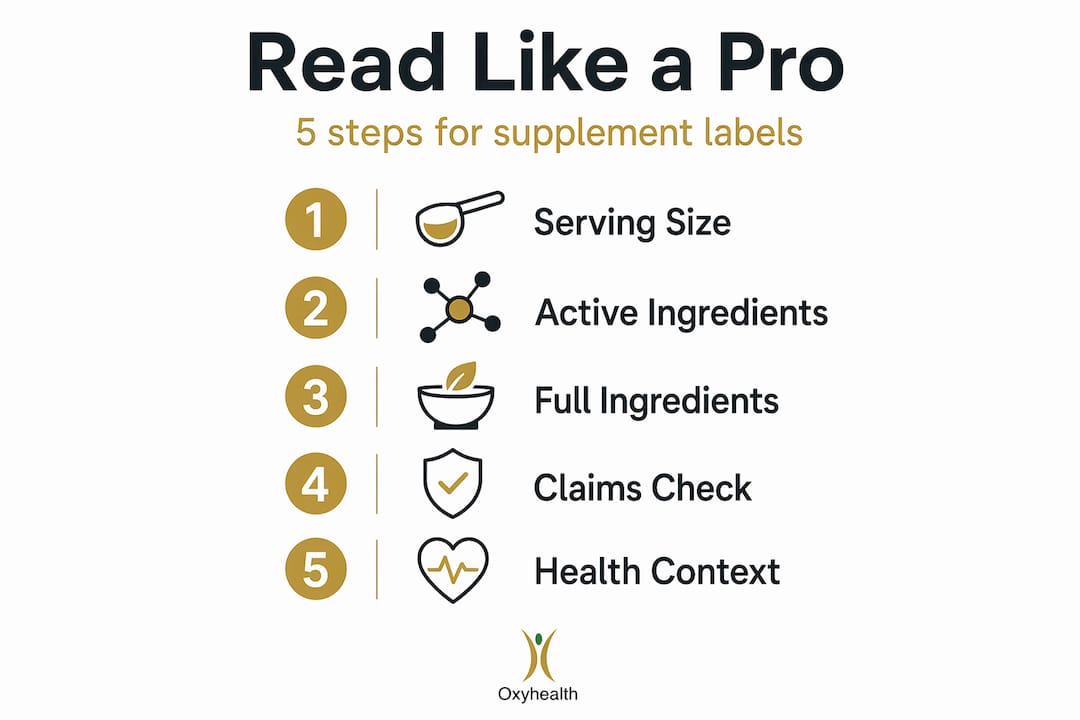
Step 2: Check the active ingredients. Look each primary ingredient up against a recognised daily intake reference, such as the NHS reference values or a registered dietitian’s guidance. A dose significantly below the evidence-based threshold is unlikely to deliver the benefit being advertised.
Step 3: Scrutinise the full ingredient list. Fillers like magnesium stearate or silicon dioxide are common and generally harmless. Artificial colours, synthetic binders, or hidden allergens such as gluten or soy are worth flagging. If you have known sensitivities, this step is non-negotiable.
Step 4: Evaluate claims critically. Any label making a structure/function claim should carry a disclaimer. If it does not, that is itself a red flag. Review health claims with healthy scepticism. Understanding the legal limits of supplement claims puts you in a much stronger position as a buyer.
Step 5: Match the label to your health context. High-dose iron supplements are appropriate for some people and potentially harmful for others. Always consider your existing diet, health conditions, and any medications before starting a new supplement. A short consultation with a GP or pharmacist is worth far more than any label claim.
Pro Tip: When decoding dietary supplements with proprietary blends, know that manufacturers are not required to disclose individual ingredient amounts within the blend. If a “proprietary formula” is listed, you genuinely cannot verify whether the active compound is present at a meaningful dose.
Common mistakes when interpreting supplement labels
Even informed buyers make consistent errors. Being aware of them sharpens your label-reading considerably.
- Ignoring serving size. A container appearing to offer 90 servings may only provide a two-month supply if the effective dose is two capsules twice daily. Misreading this leads to unintended underdosing or overconsumption.
- Trusting proprietary blends. These are ingredient groupings listed with a combined weight rather than individual amounts. They are legal, common, and make it almost impossible to verify whether active ingredients reach therapeutic levels.
- Taking front-of-pack claims at face value. The Supplement Facts panel is where regulated data lives. The front of the packet is where the persuasion starts. Treating both with equal weight is one of the most expensive mistakes in supplement buying.
- Missing or misreading disclaimers. Ignoring disclaimers on structure/function claims can give false confidence about a product’s therapeutic effect. The disclaimer exists precisely because the claim lacks the evidence required for a medical one.
- Overlooking interactions. Some supplement ingredients interact with prescription medications or medical conditions. St John’s Wort, for example, is well documented to interfere with several common drugs. The label will rarely highlight this clearly.
Verifying quality beyond the label
Reading the label is only part of the process. Supplement label literacy becomes significantly more powerful when combined with external verification methods.

Third-party testing is one of the most reliable quality signals available. Certifications from organisations such as the US Pharmacopeia (USP), NSF International, or Informed Sport indicate that an independent body has verified the product’s contents, purity, and potency. These seals appear on the label but are awarded externally, making them meaningfully different from manufacturer claims.
| Verification method | What it checks | Reliability |
|---|---|---|
| USP Verified | Ingredients, potency, purity, dissolution | High |
| NSF Certified | Label accuracy, contaminants, banned substances | High |
| Informed Sport | Banned substance testing for athletes | High for sport use |
| Manufacturer website | Claimed sourcing and process transparency | Moderate |
| GP or pharmacist advice | Clinical suitability for individual needs | High |
Beyond certifications, use reputable supplier resources and independent health information from organisations such as the NHS or registered dietitian bodies. For specialist health contexts, healthcare professional insights on evaluating supplement evidence can help you interpret what is and is not backed by meaningful research. Simpler, more minimal labels often correlate with fewer unnecessary additives and more transparently formulated products. If a label requires a magnifying glass and a marketing degree to understand, that is itself worth noting.
My take on why label literacy matters more than ever
I have spoken with a lot of people who spend serious money on supplements and genuinely believe they are making well-informed choices. Most of the time, they are making brand choices, not ingredient choices. They recognise the packaging, they like the claims, and they trust the company. That is understandable, but it is not the same thing as reading the label.
What I have learnt over time is that regulatory frameworks offer far less protection than most people assume. The disclaimer printed in small text at the bottom of a label is not a technicality. It is a legal acknowledgement that the product’s central claim has not been independently verified to treat or prevent anything. Consumers who understand that distinction shop very differently to those who do not.
My honest view is that the supplement industry, taken as a whole, is not designed to make it easy for you to evaluate what you are buying. The front-of-pack claims, the proprietary blends, the aspirational language, all of it is built to create confidence rather than convey information. Building your own supplement label guide, a personal framework for what to check and what to question, is not optional if you want your spending to actually support your health. The investment of thirty minutes learning to interpret supplement facts pays for itself many times over.
— John
Supplements you can actually trust
Once you know what to look for on labels, finding products that meet those standards becomes much easier. At Oxyhealth, transparency is not an afterthought. Every product in the Oxyhealth supplements range comes with clear labelling, fully disclosed ingredient amounts, and sourcing that reflects genuine quality standards rather than marketing convenience.
Whether you are exploring detox and cleanse options or looking for a specific vitamin or mineral support, the Oxyhealth catalogue is built for the kind of informed buyer this guide is designed to create. All orders over £50 qualify for free UK delivery, with same-day dispatch for orders placed before 2 p.m. And if you are ever unsatisfied, a 365-day guarantee backs every purchase. You have done the work of learning to read labels properly. Oxyhealth makes it straightforward to put that knowledge into practice at oxyhealth.co.uk.
FAQ
What is the most reliable part of a supplement label?
The Supplement Facts panel and the full ingredient list are the most regulated sections on any supplement label. According to nutritional health experts, these sections provide the most trustworthy information compared to front-of-pack marketing language.
What does a structure/function claim disclaimer mean?
A structure/function disclaimer means the product’s stated benefit has not been evaluated by a regulatory authority to treat, cure, or prevent any disease. It is legally required under DSHEA but does not indicate the claim is false, only that it lacks medical-grade substantiation.
Are terms like “natural” and “organic” regulated on supplement labels?
“Organic” carries legal weight when a named certification body is referenced, but “natural” has no strict regulatory definition on supplement packaging. Treat both terms as starting points for further investigation rather than quality guarantees.
How do I spot a low-quality supplement from the label alone?
Look for proprietary blends with no individual ingredient amounts disclosed, an absence of third-party certification seals, and a front panel heavy with vague claims and light on verifiable facts. Simpler, clearer labels tend to indicate better-formulated products.
Why should I check the serving size before anything else?
Every nutrient figure on the Supplement Facts panel is calculated per serving, not per container. Misreading or overlooking the serving size is one of the most common errors in supplement use and can result in either ineffective dosing or unintentional overconsumption.