
Your essential guide to effective organic skin care
TL;DR:
- Organic skincare is made from ingredients grown without synthetic chemicals and often has certifications.
- Building a simple routine with gentle cleansers, targeted oils, and sun protection yields better results.
- Verify claims by checking certification logos, ingredient lists, and tracking skin progress over time.
Finding natural skin care that genuinely works can feel like searching for something that doesn’t exist. Shelves overflow with products claiming to be ‘clean’, ‘green’, and ‘natural’, yet many deliver disappointing results or cause unexpected reactions. Greenwashing, vague labelling, and conflicting advice make it genuinely hard to know what to trust. This guide cuts through the noise. You’ll learn exactly what organic skin care means, which ingredients and habits are backed by evidence, how to build a routine suited to your skin, and how to verify that what you’re buying is the real thing.
Table of Contents
- Understanding the essentials: What is organic skin care?
- What you need: Ingredients, tools, and storage essentials
- Step-by-step: Building your organic skin care routine
- Common pitfalls and how to personalise your routine
- How to verify claims and track your results
- A fresh perspective: Why ‘organic’ isn’t always the whole answer
- Discover organic solutions for your routine
- Frequently asked questions
Key Takeaways
| Point | Details |
|---|---|
| Know what organic means | Organic skin care focuses on natural ingredients but is not always better or risk-free. |
| Start with essentials | Build your routine using a few carefully chosen organic basics and add more over time as needed. |
| Check for real results | Read labels, verify certifications, and track your skin’s response to avoid hype and greenwashing. |
| Minimalism trumps trends | A simple, evidence-based routine often outperforms chasing the latest organic product. |
Understanding the essentials: What is organic skin care?
The terms ‘organic’, ‘natural’, and ‘conventional’ are often used interchangeably, but they mean very different things. Organic skin care refers to products made from ingredients grown without synthetic pesticides, herbicides, or fertilisers, and certified by a recognised body such as the Soil Association in the UK. Natural is a looser term with no legal definition, meaning almost any brand can use it freely. Conventional products rely on synthetically derived compounds, many of which have decades of safety data behind them.
So, what does going organic actually offer? Organic skincare is gentler, nutrient-rich, and potentially eco-friendly, though it typically has a shorter shelf-life and variable results depending on the individual. Environmental impact is a genuine benefit, as certified organic farming reduces chemical runoff and supports biodiversity. Our sustainable wellness explained resource explores this connection in more detail.
It’s worth noting that the organic foods evidence base is still growing, and the same applies to topical skin care. Results are modest and highly individual. The NHS, for its part, recommends emollients for dry and sensitive skin based on efficacy rather than ingredient source, which is a useful reminder that outcomes matter more than labels.
“The best skin care product is the one that works for your skin, regardless of whether it carries an organic label.”
Key terms to look for on product labels include:
- Certified organic: Verified by a third-party body (e.g., Soil Association, COSMOS)
- Natural origin: Ingredient derived from a plant or mineral source, not necessarily organic
- Free from: No guarantee of organic status; simply excludes specific ingredients
- Hypoallergenic: Reduced risk of reaction, not zero risk
| Feature | Organic | Natural | Conventional |
|---|---|---|---|
| Certified growing standards | Yes | No | No |
| Synthetic preservatives | Rarely | Sometimes | Often |
| Shelf-life | Shorter | Varies | Longer |
| Environmental impact | Lower | Varies | Higher |
For a broader look at how what you eat supports your skin, our skin nutrition guide is a helpful companion read.
What you need: Ingredients, tools, and storage essentials
With a clear understanding of the basics, it’s time to gather everything needed for an effective organic skin care routine. Knowing which ingredients to look for, and which to approach with caution, makes all the difference.
Essential organic ingredients to look for:
- Tea tree oil: Antimicrobial, commonly used for blemish-prone skin
- Shea butter: Rich emollient, excellent for dry and sensitive skin
- Rosehip seed oil: High in vitamin A and C, supports skin renewal
- Jojoba oil: Closely mimics the skin’s natural sebum, suitable for most skin types
- Aloe vera: Soothing and hydrating, ideal for reactive or sun-exposed skin
- Chamomile extract: Anti-inflammatory, calming for redness
When comparing organic to conventional products, it helps to see the trade-offs clearly:
| Factor | Organic products | Conventional products |
|---|---|---|
| Average shelf-life | 6 to 12 months | 1 to 3 years |
| Preservative use | Minimal | Common |
| Sensitivity risk | Can be higher | Generally lower |
| Cost | Often higher | Varies widely |
| Certification available | Yes | Rarely |
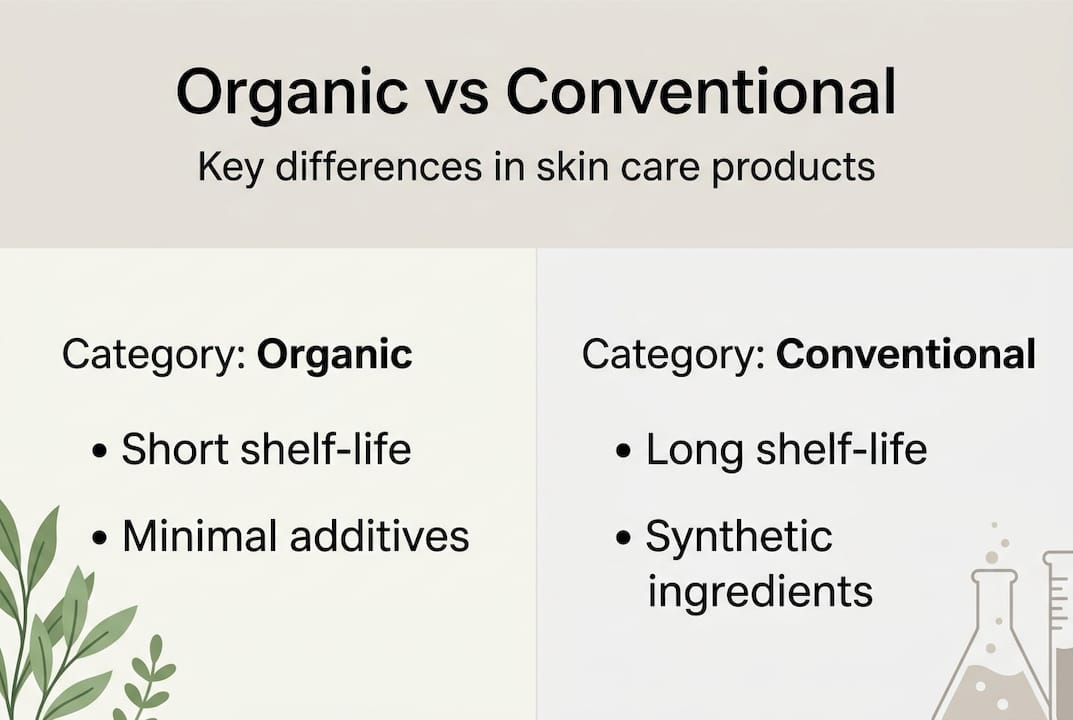
Organic products may carry a higher price, a shorter shelf-life, and a risk of contamination due to fewer preservatives. They are also not always hypoallergenic, which surprises many people. Our guide on avoiding synthetic ingredients explains what to watch for when reading labels.
For storage, keep organic products away from direct sunlight and heat, as natural oils and plant extracts degrade faster than synthetic alternatives. A cool, dark cupboard or bathroom cabinet away from steam is ideal. Always use clean hands or a spatula to avoid introducing bacteria into jars.
The NHS advice on moisturisers recommends applying emollients frequently and generously, which is equally relevant when using organic alternatives.
Pro Tip: Always patch test a new product on the inside of your wrist or behind your ear for 24 hours before applying it to your face. Check expiry dates every time you restock.
Browse our curated range of organic skin care products to find options suited to your skin type and routine.
Step-by-step: Building your organic skin care routine
Once you have your essentials ready, it’s time to create a routine that’s right for you. A consistent, simple approach will almost always outperform an elaborate one you can’t maintain.
Daily organic skin care routine:
- Cleanse: Use a gentle, certified organic cleanser morning and evening. Avoid anything that leaves skin feeling tight or stripped.
- Treat: Apply targeted serums or facial oils (such as rosehip or vitamin C) while skin is still slightly damp to improve absorption.
- Moisturise: Lock in hydration with a nourishing emollient. Our ozonated olive oil moisturiser is a popular choice for those seeking a clean, effective option.
- Protect: In the morning, apply a broad-spectrum SPF over your moisturiser. Look for mineral-based formulas (zinc oxide or titanium dioxide) for a more natural option.
- Support from within: Diet plays a significant role. Antioxidant-rich foods, adequate hydration, and targeted supplements support skin health from the inside out.
Morning vs night adjustments: In the morning, focus on lighter textures and sun protection. At night, your skin enters repair mode, so richer oils and treatment products work harder while you sleep.
Essential oils such as tea tree for acne and lavender or rosemary for their anti-inflammatory and anti-ageing properties show genuine promise, though more large-scale clinical trials are still needed. Notably, over 70 studies have examined tea tree oil’s potential for reducing acne, making it one of the better-researched natural actives available.
For those interested in supporting skin health from within, our natural skin detoxification guide covers complementary approaches worth exploring.
Pro Tip: If you have sensitive skin, start with just two or three products and introduce new ones one at a time, leaving at least two weeks between additions. Fewer products means fewer variables if a reaction occurs.
Common pitfalls and how to personalise your routine
After setting up your daily routine, knowing the common mistakes will help you stay on track and get the best results. Even well-intentioned routines can go wrong.
Pitfalls to avoid:
- Switching too quickly: Give each product at least four to six weeks before judging its effectiveness. Skin cycles take time.
- Product overload: Using too many actives at once overwhelms the skin barrier and makes it impossible to identify what’s helping or causing problems.
- Skipping patch tests: Even ‘natural’ ingredients can trigger reactions. Never assume an organic product is automatically safe for your skin.
- Falling for greenwashing: Words like ‘green’, ‘eco’, and ‘botanical’ carry no legal weight. Always look beyond the marketing language.
Natural and organic products can still irritate; a hybrid approach that combines evidence-based conventional ingredients with organic options is often more realistic and effective than going fully organic overnight.
“Persistent redness, stinging, or breakouts after using a new product are signals to stop immediately and reassess, not to push through.”
Personalising for your skin type:
- Oily skin: Lightweight jojoba or squalane oils, clay-based cleansers, non-comedogenic formulas
- Sensitive skin: Fragrance-free, minimal ingredient lists, chamomile or oat-based products
- Mature skin: Rosehip oil, bakuchiol (a natural retinol alternative), rich emollients and antioxidant serums
If you experience a severe reaction such as swelling, hives, or difficulty breathing, seek medical advice promptly. For persistent irritation, a dermatologist can help identify specific triggers. Connecting nutrition and skin health is another layer worth exploring alongside your topical routine.
Pro Tip: Ignore the price tag and the front label. Flip the product over and read the ingredient list. That’s where the truth lives.
How to verify claims and track your results
Even with the best routine, ongoing success depends on knowing how to spot genuine products and track your skin’s progress. Greenwashing is rampant, and without a system, it’s easy to waste money on products that don’t deliver.
How to verify organic claims:
- Check for certification logos: Look for Soil Association, COSMOS Organic, or Ecocert marks on the packaging.
- Read the INCI list: The International Nomenclature of Cosmetic Ingredients (INCI) list shows every ingredient in descending order by concentration. If a ‘hero’ ingredient appears near the bottom, it’s present in a negligible amount.
- Research the brand’s transparency: Reputable brands publish their sourcing, testing, and manufacturing practices openly.
- Cross-reference claims: If a brand claims clinical results, look for published studies or independent testing, not just testimonials.
Focusing on INCI lists and ingredient transparency is the most reliable way to avoid empty marketing promises. The emerging research on skin microbiome and probiotics is also worth following as ingredient science advances.
Tracking your results:
| What to track | How often | Method |
|---|---|---|
| Skin hydration and texture | Weekly | Written notes or app |
| Breakouts or redness | Daily | Photo log |
| Product reactions | As they occur | Ingredient diary |
| Overall skin tone | Monthly | Before/after photos |
Keeping a simple log removes guesswork. Take a photo in natural light every two to four weeks under the same conditions. Note what you used, when, and how your skin responded. Over time, patterns emerge that no product marketing can replicate. Our resource on verifying organic claims offers further guidance on cutting through misleading labelling.
A fresh perspective: Why ‘organic’ isn’t always the whole answer
Having grasped the how-to details, consider a broader perspective on what truly matters for your skin’s long-term health. The organic label, for all its appeal, is not a guarantee of results. Many natural irritants exist in certified organic products, from essential oils to botanical extracts, and individual responses vary enormously.
The health benefits from organic are real but modest, and they depend far more on holistic habits and diet than on any single product. What consistently delivers results is supporting the skin barrier with effective emollients, eating a varied diet rich in antioxidants, staying hydrated, and being selective about what you actually apply. Our holistic nutrition for skin guide explores this connection in depth.
Minimalism wins. A three-step routine followed consistently will outperform a ten-step routine used sporadically. Chasing every new ‘superfood’ ingredient or trending botanical often leads to product overload and confused skin. Think critically, observe your own results, and let the evidence, not the branding, guide your choices.
Frequently asked questions
Are organic skin care products better for sensitive skin?
Organic products can be gentler, but they are not always hypoallergenic and may contain irritant essential oils. Always patch test and check ingredient lists carefully before committing to a new product.
How long do organic skin care products last?
Most organic skin care products have a shelf-life of 6 to 12 months due to fewer preservatives, compared to one to three years for conventional alternatives. Always check the expiry date and store products correctly to maximise their potency.
Do essential oils like tea tree really help acne?
Systematic reviews suggest tea tree is effective for acne, but longer-term, large-scale clinical trials are still needed to confirm the full extent of its benefits.
How do I check if a product is truly organic?
Look for recognised third-party certification logos such as Soil Association or COSMOS, and read the INCI ingredient list carefully to avoid greenwashing and verify genuine organic content.