What is organic skincare? A guide to certified beauty
TL;DR:
- In the UK, there is no legal definition for “organic” in skincare, making third-party certification essential to verify genuine organic content. Certification logos like COSMOS and the Soil Association confirm independent audits of ingredients, manufacturing, and organic percentages, unlike self-declared claims. Consumers should rely on certification logos and ingredient lists, rather than marketing language, to choose trustworthy organic skincare products.
Walk down any UK pharmacy aisle and you will see shelves packed with products screaming “organic,” “natural,” and “clean.” But spend five minutes reading the labels and the picture grows murky fast. Unlike organic food, there is no single law that defines what “organic” means on a skincare product, which means brands can use the word loosely, and many do. Understanding what genuinely separates a certified organic product from clever marketing is not just good sense — it can change how your skin responds, how your money is spent, and how confidently you shop.
Table of Contents
- How is organic skincare defined in the UK?
- Organic vs natural skincare: What’s the difference?
- Which certifications matter? Understanding logos and standards
- How to spot authentic organic skincare when shopping
- Common myths and pitfalls: What certification cannot tell you
- A fresh perspective: Why ‘organic’ is only the starting point for true skin health
- Get started with trusted organic skincare solutions
- Frequently asked questions
Key Takeaways
| Point | Details |
|---|---|
| Certification is key | Rely on trusted certification logos like COSMOS or Soil Association to identify genuine organic skincare. |
| Organic vs natural | ‘Organic’ has stricter, third-party standards compared with the less-regulated term ‘natural’. |
| Check ingredients and claims | Not all ‘organic’ labels mean the whole product is certified — always verify the scope and ingredient percentages. |
| Certification has limits | Even certified products may not suit every skin type, so patch testing and personal research remain vital. |
| Be a label detective | Understanding logos, legalities, and marketing claims protects you from misleading marketing and helps improve your skin care routine. |
How is organic skincare defined in the UK?
When you pick up a jar labelled “organic face cream,” you might reasonably assume it has been inspected and certified by someone official. In the world of food, you would be right. But skincare operates in very different regulatory territory.
Unlike organic food, which is governed by strict GB organic regulations, there is no single legal definition for organic cosmetics in the UK. Any brand can print the word “organic” on a bottle without meeting a single external standard. This is why so many products carry the label without ever having been independently reviewed.
The trusted solution to this gap is third-party certification. As the Soil Association confirms, “organic skincare” is usually defined by certification under a recognised standard like COSMOS or Soil Association COSMOS Organic, not just by a marketing claim. That distinction matters enormously.
When a product carries a recognised certification logo, it means an independent body has audited:
- The source and quality of every ingredient
- The manufacturing process and facilities
- The percentage of organic content present in the formula
- Ongoing compliance through regular re-audits
A self-declared claim carries none of that accountability. The brand simply decides to use the word and prints it. There is no audit trail, no minimum percentage requirement, and no external check. That is a very different thing from a product that has earned its logo through scrutiny.
If you are new to this territory, our effective organic skin care guide is a great starting point, and you can also browse our range of UK certified skin care products to see what genuine certification looks like in practice.
“The word ‘organic’ on a skincare label means nothing unless it is backed by a recognised certification standard. Look for the logo, not just the claim.”
Organic vs natural skincare: What’s the difference?
Now that you know how “organic” is defined, let us explore how it compares to “natural,” which is often confused or conflated by both brands and consumers.
The two terms feel interchangeable in everyday conversation, but in the skincare world they describe very different standards of scrutiny. “Natural” typically refers to products made with ingredients derived from nature rather than synthesised in a laboratory. That sounds reassuring. The problem is that “natural” skincare has historically been less strictly regulated than certified organic products, making third-party logos crucial for trust.
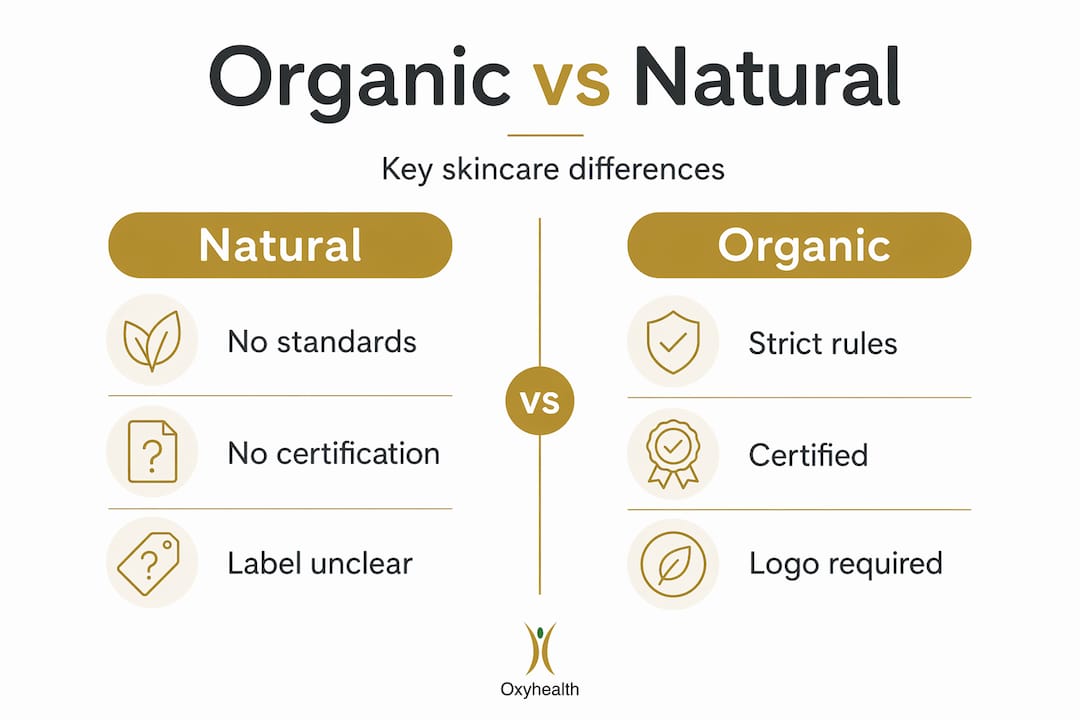
Here is a clear comparison to help you tell them apart:
| Feature | Natural skincare | Organic skincare |
|---|---|---|
| Legal definition | None in UK cosmetics | None, but certification fills the gap |
| Third-party audit | Not required | Required for certification |
| Ingredient sourcing rules | No standard | Strict under COSMOS/Soil Association |
| Minimum organic content | Not specified | Defined by certification tier |
| Synthetic ingredient restrictions | Variable | Tightly controlled |
| Consumer accountability | Self-declared | Independently verified |
There are edge cases worth knowing about too. Some products market themselves as “made with organic [ingredient]” and that single ingredient might genuinely be certified organic. The rest of the formula, however, could contain synthetic preservatives, petrochemical derivatives, or non-certified plant extracts. This is a common tactic that technically avoids misleading claims while still creating a false impression.
Key things to look for when comparing the two:
- A “natural” product may use the term freely with no oversight
- An “organic” product with a logo has been independently verified
- “Made with organic ingredients” is not the same as a fully certified organic product
- Certified products specify what percentage of the formula is truly organic
Pro Tip: When comparing labels, ignore the front-of-pack claims entirely. Turn to the ingredients list and look for the certification logo. If there is no logo from COSMOS or Soil Association, the “organic” or “natural” claim is self-declared at best.
For further reading on how this applies beyond skincare, take a look at our piece on natural products versus organic and our skin detox guide, which explores how detoxification and ingredient purity connect.
Which certifications matter? Understanding logos and standards
With an understanding of the difference between organic and natural, let us look closer at the logos and standards you should trust on the shelf.
Two certifications dominate the UK and European organic skincare market: COSMOS and the Soil Association. Both are credible, independently audited, and widely recognised. Here is what they mean in practice:
| Certification | Full name | What it guarantees |
|---|---|---|
| COSMOS Organic | Certified Organic and Natural Standard | High percentage of organic ingredients, restricted synthetics, sustainable sourcing |
| COSMOS Natural | Certified Organic and Natural Standard | Naturally sourced ingredients, does not require high organic content |
| Soil Association COSMOS Organic | UK’s leading organic certification | Follows COSMOS standards with additional Soil Association requirements |
COSMOS standards define “COSMOS Organic” and “COSMOS Natural” precisely, specifying ingredient sourcing, permissible manufacturing processes, and criteria through accredited certification bodies. This is what gives those logos genuine authority.
Here is how to use logos effectively when shopping:
- Identify the logo on the packaging. Look for the Soil Association leaf symbol or the COSMOS logo. They appear on the front or back label.
- Check which tier it represents. “COSMOS Organic” is the higher standard. “COSMOS Natural” confirms natural sourcing but is not organic certified.
- Read the ingredient list alongside the logo. Certified products will often indicate which ingredients are organically sourced with an asterisk.
- Verify online if you are unsure. The Soil Association and COSMOS both maintain public databases of certified brands and products.
- Check the scope of the certification. Some certifications apply only to specific product lines, not an entire brand range.
As the Soil Association guidance confirms, checking for a recognised certification logo and confirming the declared ingredient percentages is the most reliable shortcut for shoppers. Do not rely on colour schemes, earthy packaging, or descriptive language to signal genuine certification.
Pro Tip: The Soil Association’s certified brands directory is free to use and searchable online. Before buying a new brand, a 30-second check there can save you from falling for a convincing but unverified label.
If you want to see what certified organic skincare looks like up close, our certified organic facial mist is a strong example of what transparency and verified sourcing can offer.
How to spot authentic organic skincare when shopping
Equipped with logo awareness, here is how you can confidently navigate organic skincare aisles and avoid misleading claims.

The shopping experience for skincare can feel overwhelming. Products use words like “pure,” “botanical,” “clean,” and “earth-friendly” in ways that deliberately blur the lines. Developing a few practical habits makes the whole process much clearer.
As Soil Association guidance reaffirms, checking the certification logo and the declared ingredient percentages is the most reliable shortcut for shoppers. Keep that front of mind.
Here are the steps that genuinely work:
- Start with the logo, not the name. A product called “Pure Organic Botanicals” means nothing without a certification logo to back it up.
- Check ingredient percentages. Certified products often declare the percentage of organic content. A figure like “95% of total ingredients are natural origin” or “20% organic ingredients” is meaningful when tied to a certification.
- Watch out for “organic-inspired” language. Phrases like “inspired by nature,” “organic philosophy,” or “as pure as organic” are marketing constructs, not standards.
- Distinguish full product certification from ingredient certification. “Contains organic shea butter” is not the same as a fully certified organic moisturiser.
- Read the entire ingredient list. Even certified products may include non-organic water (water is never classified as organic). The key is the ratio and sourcing of the active components.
- Be wary of very low prices. Genuine organic certification involves cost. A cream claiming to be fully organic and priced significantly below the market norm deserves scrutiny.
One useful stat: industry research has found that a significant proportion of products marketed using the word “organic” do not carry any third-party certification at all. That number varies by category and retailer, but it underlines how common the gap between claim and reality actually is.
Pro Tip: Photograph or note down the certification logo you see on a product before buying. Then verify it against the certifier’s public database. This takes less than two minutes and gives you genuine confidence in your purchase.
For trusted recommendations already vetted for quality, our effective skin care tips page walks through what to prioritise, and our ozonated olive oil moisturiser demonstrates how ingredient transparency shapes a genuinely clean product.
Common myths and pitfalls: What certification cannot tell you
Even the best certifications have limits, so it is vital to understand what they cannot tell you about the product you are about to put on your skin.
Certification is a powerful quality signal, but it is not a safety guarantee for every individual. Here is where many shoppers go wrong.
Certification audits sourcing, not your skin. As COSMOS standard documentation makes clear, certification schemes audit ingredients, supply chains, and manufacturing practices, but product efficacy and irritation potential depend on specific actives and your skin type. Certification is not a guarantee of performance.
Common myths to let go of:
- “Certified organic means hypoallergenic.” Natural plant extracts are among the most common triggers for contact dermatitis. Essential oils, botanical extracts, and even organically grown herbs can irritate sensitive skin.
- “A non-certified product cannot be effective.” Some high-quality products use organically sourced ingredients that simply have not gone through a formal certification process. The audit trail is missing, but the ingredients may still be genuinely excellent.
- “Certification means the product is safe for everyone.” Safety depends on your specific skin profile, allergies, and existing conditions, not on a label.
- “Organic products cannot contain any synthetics.” Under COSMOS standards, certain synthetic ingredients are permitted when they meet specific safety and sustainability criteria.
Additionally, under UK law, non-food organic claims must still be truthful even though cosmetics are not covered by the same food regulations. Brands cannot legally make false claims, but the absence of a specific cosmetics law means enforcement is less straightforward than in the food sector.
“A certification logo tells you how a product was made and where its ingredients came from. It does not tell you how your skin will respond. Both facts matter.”
For a deeper look at what the evidence actually says about certified organic products, visit our deep dive into organic efficacy where we separate what works from what is simply well-marketed.
A fresh perspective: Why ‘organic’ is only the starting point for true skin health
We work with a lot of health-conscious consumers in the UK, and we have noticed a pattern. The moment someone discovers certification standards, they sometimes go to the other extreme — dismissing everything without a COSMOS logo as untrustworthy, and treating every certified product as automatically superior.
That is too rigid a framework, and it misses something important.
Organic certification signals that a brand has made a genuine commitment to ethical ingredient sourcing and ecological responsibility. That is meaningful. It says the company cares enough to be audited, to pay for ongoing compliance, and to meet standards that most competitors sidestep. But it does not make the product right for your skin. A certified product packed with high-concentration essential oils may irritate someone with reactive skin far more than a simple, uncertified moisturiser with five basic ingredients.
The most effective evidence-based organic skin care approach combines certification literacy with personal awareness. Start by using certifications as your first filter — they thin the crowd considerably and remove the most obviously misleading products from consideration. Then go further. Patch test every new product before applying it to your face. Keep a simple note of which actives trigger reactions for your skin. Understand whether your skin is dry, oily, combination, or sensitive, and use that as your second filter.
The uncomfortable truth is that no logo replaces self-knowledge. Brands that are transparent about their ingredients, their sourcing, and their certification status are worth supporting. But the product that ultimately earns a permanent place in your bathroom cabinet is the one that works for you, reliably and consistently, over months of use. Certification gets you closer to the right starting line. Your own skin tells you when you have found the finish.
Get started with trusted organic skincare solutions
Ready to apply your knowledge? The research is done and the framework is clear — now it is about finding products you can trust from day one.
At oxyhealth.co.uk, we stock skincare products where ingredient integrity and transparency are non-negotiable priorities. Whether you are looking for a certified organic mist, a clean-formulation moisturiser, or want to understand which certified options suit your skin type, our collection brings quality and clarity together. Orders placed before 2 p.m. are dispatched the same day, with free delivery on orders over £50, backed by our 365-day satisfaction guarantee. Explore organic skin care from brands that take certification seriously, and take the first confident step towards a healthier, better-informed skin care routine.
Frequently asked questions
What is the main difference between organic and natural skincare?
Organic skincare is certified to independent standards with strict rules around ingredient sourcing and manufacturing, while “natural” skincare is less strictly regulated and may not be certified or audited at all.
How can I know if a skincare product is truly organic?
Look for recognised certification logos such as COSMOS or Soil Association on the label, and check the declared ingredient percentages to confirm the certification scope and organic content.
Are organic skincare products guaranteed to be safer for my skin?
No. Certification primarily addresses ingredient sourcing and manufacturing rules, but does not guarantee personal efficacy or that the product will suit your particular skin type.
Is organic skincare regulated the same as organic food in the UK?
No. Cosmetics are not covered by food organic regulations, though non-food claims must still be truthful under UK law and brands cannot legally mislead consumers about organic content.
Does every ‘organic’ skincare label mean the full product is certified?
No. Sometimes “organic” refers only to one or two specific ingredients, and some brands use the term in a marketing sense without meeting a full product certification threshold. Always check for a whole-product certification logo.